Showing posts with label computers. Show all posts

Friday, December 21, 2012

An Open Letter to MMO Developers

An Open Letter to MMO Developers
– by David Matthews 2

This is an open request to Massive Multimedia Online Role-Playing Game developers and their corporate managers:

Stop trying to kill World of Warcraft!

That may sound a little confusing, so bear with me while I clarify.

I keep hearing the phrase “WOW-Killer” from reviewers and developers as though the purpose of any MMO program is to utterly destroy World of Warcraft (aka “WOW”).  I know it’s more of a competitive mindset and a somewhat lofty goal to be able to knock the biggest name in MMORPG off its pedestal.  But if that is truly your goal, then in all likelihood you will fail at it.

Is it impossible to defeat the Elite Boss of MMOs?  No.  Warcraft can be beat.  But it’s not going to be beat by a company that is fixated on just doing that.

The MMO market is in a bit of a transition right now.  The old subscription-based model worked when the economy was capable of keeping people employed with a steady income.  But those days are over with and the Great Recession really stripped a lot of income away from the very users that would otherwise be paying for a regular subscription.  Today the trend is the hybrid of subscription along with free-to-play and pay-for-features.  Free-to-play gets the users to start playing the game, and to allow normal subscribers to keep playing the game should the economy force them to drop their subscription for a limited time.  And pay-for-features allows MMO developers to figure out which features are really popular with the user-base.

So that’s really what the MMO developers and their corporate managers need to focus on first and foremost: survival.  You’re not going to be able to beat Warcraft if you’re not still standing after they fall.

Another thing that self-professed “WOW-Killer” companies fail to do is they fail to advertise that their MMO even exists. 

I’ve never played World of Warcraft, but I can tell you that their latest expansion is called “Mists of Panderia”.  How do I know this?  Because Blizzard Entertainment spends big money into letting people know about it.  It’s on the TV and in magazines.  You go to your local big-box superstore and you’ll find it displayed in their electronics section.  In fact, you’ll probably find it easier than you would the latest Microsoft operating system or the newest anti-virus security suite.

Yes, Blizzard Entertainment spends the money for Vern Troyer and Mr. T and William Shatner to talk about the joy of being gamers.  T can even brag about his “Mohawk Grenade” and claiming to know something about being a programmer.  It’s funny.  But the question to those other companies that claim to want to beat Warcraft is this: where’s your TV spot?  Oh, and “YouTube” is not an acceptable answer.

You want to beat Warcraft?  There is the venue that you’ll need to play in to do it.  If you’re not willing to pony up the money for that kind of advertising, then don’t even start trying to claim to be able to compete with them, much less beat them.

Then there’s this: how can you “beat” Warcraft if your MMO is just like it?

Take a look at your MMO.  Can you describe it without you making any comparisons to Warcraft?  If the person you’re describing this to responds with “So it’s like Warcraft but…”, then you’ve failed.

“It’s a fantasy world of swords and sorcery where you develop your skills and relationships through team activities.”  Sorry, but that’s Warcraft.

“It’s a fantasy galaxy of lasers and blast-cannons where you advance in rank and create your army through team activities.”  Sorry, but that’s Warcraft in space.

“It’s a fantasy city of capes and cowls, where heroes develop their powers and organize into super-legions with other heroes.”  Sorry, but that’s Warcraft with capes.

Take a look at Star Wars: The Old Republic MMO.  One MMO reviewer came to the realization that the whole player interface was pretty much ripped off from Warcraft.  In fact, he even showed the screens of the two games and showed how SWTOR mirrored Warcraft’s activities.

I’m going to go on a limb and make a prediction here: the MMO that replaces Warcraft on the top of the heap will be something that is so different that people won’t make comparisons to Warcraft.

The last way that you can beat World of Warcraft is this: by not continually competing against it. 

The now-defunct City of Heroes MMO earned a huge support base because the developers didn’t try to compete against Warcraft.  Rather, the developers at Paragon Studios worked to make their MMO to be the best possible in the superhero genre, so when all other superhero MMOs came out, from Champions Online to DC Universe Online to the future Marvel MMOs, those MMOs were compared to City of Heroes instead of Warcraft.  The MMO was bringing in over two million dollars a year in steady income with almost no advertising whatsoever.  That’s all from the steady user-base.  And when NCSoft made the mistake of shutting that game down, the whole MMO world knew about it, and even their competition showed their respect and appreciation for the game. 

And, really, the biggest threat for World of Warcraft is not the competition, but rather it is the corporate hands that feed them.  Paragon Studios and City of Heroes found out about that all-too-well with their own parent company, and, one day, the people behind World of Warcraft will realize it with Blizzard.

Maybe there’s a new MMO that people are flocking to.  Maybe the gold-farming spammers have overwhelmed the servers.  Maybe there’s a team of game griefers that make the experience too troubling for the others.  Maybe the developers make the mistake of not listening to the users and come up with things that nobody wants to pay for.  Maybe Blizzard has another MMO that they want to re-focus their corporate love.  Maybe the Blizzard bean-counters will simply declare the game unsustainable.  Whatever the reason, at some point the Blizzard execs will make the inevitable decision to shut down World of Warcraft, and then whichever MMOs are still around will be able to compete for the title of “King of the MMO Mountain”.

So the name of the game for MMO developers that really want to beat World of Warcraft is this: don’t try to be like Warcraft.  Be your own MMO.  Support and promote it.  Earn the respect and support of your user-base by making it the best in its own genre.  And when Warcraft does itself in, you’ll be in position to be the new measuring stick.


David Matthews 2 is a freelance writer living in Georgia.  He has been around computers in one form or another since the 1980’s. 

This article may be distributed freely only so long as it is reprinted in its entirety, with all proper credit given to the author.

2012 – Get Brutal Productions

Sunday, December 26, 2010

Flying and Tech

Flying and Tech
- by David Matthews 2

Over the past ten years, there have been two things that have been on the steady increase… airport security and personal technology.

Airport security has had to go on the increase because of the ever-present fear of terrorism. This has required passengers to be inconvenienced as they take off their shoes, their coats, their belts, and also take special considerations to make sure that their personal technology doesn’t get damaged from those same enhanced security measures.

Quite recently, this author had to take a trip to Oklahoma City to visit with a radio station that I work with. Having been taken to the airport extremely early to avoid hassles with security and the various check-in times, not to mention having my return flight delayed six hours due to weather, I had the opportunity to check out some of the provisions that the airports in Atlanta and Oklahoma City have for personal technology. The two airports that I visited were Hartsfield-Jackson International Airport in Atlanta, and the Will Rogers Airport in Oklahoma City. (Fortunately these were both direct flights, so there were no layovers.)

Security

As far as security goes, despite the media hype about pat-downs and body scanning, both airports I visited were using enhanced device-detection equipment, but not the “see through your clothes” scanners. This still required the removal of your coat and shoes, but it also meant removing my belt, watch, ring, and emptying my pockets of everything, even my wallet, pocket change, and plastic comb.

Most of the equipment I brought with me was in my computer carrying case or in my pocket. This consisted of my laptop computer, cellphone, Bluetooth earpiece, and a thumb drive for my data. Additional equipment, such as my plug-in electric razor and the chargers for my cellphone and earpiece, were checked in with my luggage.

When going through the security line, they provide a series of plastic bins for you to put in all of the items that have to be screen separately. Sensitive equipment like laptops and cellphones are not scanned for obvious reasons, and you are required to take your laptop out of the case. A good suggestion for travelers is to put all of your sensitive equipment (including thumb drives) in the same bin to keep them all together. Make sure this is the very first bin (or bins) scanned. And make sure you keep an eye on it after you go through it yourself to make sure that you recover everything you scanned. Due to the large volume of people that have to go through the system, it is very easy to forget something in the rush, and in both flights I heard announcements of personal belongings left behind.

Unfortunately, while both airports made accommodations for the large volume going INTO the security screening area, they fell painfully short in providing accommodations for passengers LEAVING the same area.

WiFi Access

Both airports offered wireless network access for “convenience”. While this sounds like a good service for people with laptops, when I searched the networks at Will Rogers Airport, it was listed as “unsecured”. This is not good for Internet users, and in fact some recent news stories have suggested that hackers have been taking advantage of airports providing this service to go after your personal laptop information.

Unfortunately any kind of security improvements that would make this service usable could easily be countermanded by the quest to keep the airport “safe”. So it is best to not take them up on this offer.

Kiosk Service

Another service that I saw at both airports was a kiosk for Internet access. This wouldn’t be too bad for a quick access for news or sports scores, but when it comes to personal email, even web-based email services, this would be extremely risky.

First, there is no way to make sure that your personal information wouldn’t be collected, and one should presume that with a public service like this, there would be NO privacy whatsoever.

Second, these kiosks aren’t free. They do want you to pay for the service, which means putting in your credit or debit card in there, and that is risky as well. Besides, most airports have free TV service that provide basic news, weather, and sports scores, and let’s not forget the mainstay of an airport - the newspaper stand. So there really is no need to use the kiosk for those reasons.

Tech Store

One feature that Hartsfield had at the airport terminals was a specialty store for the tech-friendly traveler. Here one could get battery chargers, replacement earphones, spare portable hard drives, and pretty much anything else that you would need for your cellphone, laptop, PDA, Blackberry, or iPhone that you may have forgotten about or got lost in your travels.

This is actually one of the better ideas for airports to include along with the array of fast-food franchises, book-and-memento stores, and the terminal bar to get people drunk before their flights. With more and more tech-friendly travelers bringing their equipment with them on the plane, there exists a great opportunity for merchants if they know how to market it right.

The one thing that I noticed, though, was the high-dollar value on some of the devices for sale. While I could see travelers getting a spare battery or some thumb drives for their laptop, I really don’t see them getting video projectors at an airport.

Tech-Friendly Areas

Finally we get to the biggest part of the airport experience… waiting around. Whether it is because you had to arrive incredibly early to avoid the traffic, or if you were forced to wait while your flight was on hold due to the weather (and I had to endure both), the terminal gate at both airports were FAR from friendly for passengers waiting for their flights.

Sadly, airport gates were never really designed for people who had to wait for any length of time. Every gate at every airport that I’ve been to have all been identical in terms of the same padded bleacher seats, an occasional table, and absolutely no place for a traveler to plug in a laptop. That’s good if your wait time before boarding was maybe ten or fifteen minutes. NOT if you’re held over for two hours.

That means if you want to set your laptop down and work on that project you need to finish, you have to go to one of the food courts or airport lounges so you can use their tables. Either that or try to find some way to get comfortable with the laptop on your lap… which, despite its name, is not always easy to do. Even then you’re at the mercy of your laptop’s battery.

Fortunately, Atlanta’s Hartsfield Airport has tech-friendly stations at their food court area in the middle of their terminals. These are bar-style eating areas with power strips running down the middle of the counter; perfect places for you to charge up your cellphone or to use your laptop without running down the battery.

Hopefully other airports can follow Hartsfield’s example in this regard, especially given the demand being made for travelers to check in earlier and earlier, plus the additional time needed to get through security. They don’t necessarily have to revamp their terminals, but to have someplace where people could sit down, plug in their electronics, and work while they wait to board their flights would certainly make the experience tolerable.

---

David Matthews 2 is a freelance writer living in the greater Atlanta area. He is a longtime computer user and has been involved with computers since the 1980’s. This article can be distributed freely provided that it is unaltered and all proper credit is given to the author.

2010 – Get Brutal Productions

Wednesday, April 21, 2010

McAFail

9am ET: McAfee sends an update to their security suite.

Not long afterward, users of Windows XP get a message saying McAfee found a critical virus and needs to reboot to remove it.


And BOOM there goes your computer!

Well, thankfully not mine.

McAfee officials were red-faced to explain how they overlooked the fact that their latest virus update would declare a crucial element of the Windows XP operating system a virus, and that removing that crucial element would force XP users into a continual reboot-and-crash scenario. Even after tens of thousands of irate McAfee customers sounded off, McAfee officials claimed that evening that they had "no idea" of the impact of their "modest mistake".

The digital fail only affected computers that used the Microsoft Windows XP SP3 operating system. The same operating system that Microsoft has been trying to force into oblivion for several years. But that still doesn't change the fact that THOUSANDS of computer users who pay for their security service were without their computers, and some of those users could not afford to be without those computers. We're talking government agencies that suddenly had to back to the 1970's, or else shut down their computer-aided services.

Even their own website blog didn't even TRY to sound apologetic for what happened, acting instead as though it was a minor inconvenience to a vast minority of computer users.

This is a huge mistake for McAfee, and not just in terms of public relations. Police departments, jails, colleges, even hospitals were affected by this gross shutdown. The deputy chief of information in the District of Columbia has now put McAfee on his blacklist. These people will probably not continue using McAfee in the near future.

It is precisely this kind of corporate indifference that Americans have come to despise, no matter the company or how essential their services are. McAfee's money isn't just in immediate software sales, but in long-term SUBSCRIPTION sales. If people cannot feel they can trust McAfee, they WILL find some other service. That is a fact of business that McAfee executives need to realize and immediately address.

Friday, August 07, 2009

A Blast From the Past

How times have changed!

Once upon a time this USED to be the hottest thing on the market. This was before the days of the Macintosh and back when Microsoft was just another version of the DOS operating system.

Ladies and gentlemen, I give you the hottest thing in 1988... the COMMODORE AMIGA.


And under $1000 back then? That WAS cheap!

Sunday, January 25, 2009

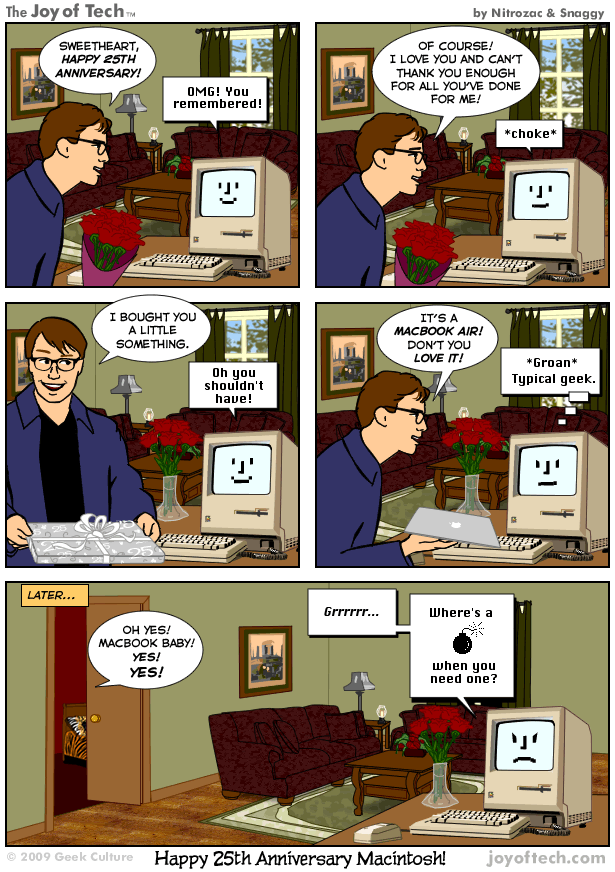
Mac at 25: Has it really been that long?

Has it really been twenty-five years ago that I was playing with a Mac? That I was writing articles and doing my reports on a Mac? That I thought that grayscale and lined textures were cool? That a little 3 1/2" square device could hold everything?
Seems more like 50. And btw, my new technolust is a Fujitsu Lifebook.

Friday, April 25, 2008

Microsoft's XP Problem

Microsoft’s XP Problem

Microsoft has a serious problem on its hands.

How do you get rid of an operating system that nobody wants to abandon?

For many years now, Microsoft users have been working with the Windows XP operating system. Sure it was buggy at first. Pretty much every operating system that has been cranked out by the House That Gates Built has had bugs and a plethora of required security fixes waiting for users the minute that welcome screen appears for the first time.

But it’s been over a year since Microsoft has come out with their brand-new operating system called Windows Vista and the response has been pretty much met with disgust. Not only are people NOT ready for a new operating system, but they are DEMANDING that they be allowed to continue to purchase and install Windows XP. Computer retailers like Dell are still offering computers with XP installed instead of Vista. Worse yet, big companies, which are usually the backbone to computer sales, are categorically REFUSING not only to install Vista, but many of them have also REFUSED to upgrade their browsers to Internet Explorer 7!

Even worse, Microsoft has been forced to push back their end-date of their support for Windows XP to April of 2009, and quite possibly even later than that.

I’m sure the Microsoft geeks and suits are pulling the remaining hairs out of their balding heads trying to figure out why. After all, weren’t these the same geeks and nerds that were complaining about XP being buggy? Sure they were! Wouldn’t they relish the new security features that are incorporated into Vista? Maybe.

But there’s more to this than just hesitation about a new system. Microsoft has really handled the Vista rollout in a way that has done the product and themselves a huge disservice.

Let’s take it by the numbers…

Bad Minimums – When Microsoft cranked out the specs for computer retailers and manufacturers to determine if their product is “Ready for Vista”, they set the bar TOO low. Sure many computers COULD run Vista. It would be slower than molasses and you wouldn’t be able to add any other programs that would use up memory on top of the basic operation of the program, but it COULD run on Vista.

As a result, there were plenty of computer systems where even the salespeople were telling you NOT to buy because it barely operated with Vista on it as opposed to XP.

Basic rule, boys and girls… EVERY new operating system demands more and more memory, more and more hard drive space, more and more processor power, and more and more of pretty much everything else a computer would use. Microsoft or Apple, it doesn’t matter. If you want a bare-bones operating system, switch to Linux. Otherwise, consider every new OS a bloated monster.

Microsoft’s “minimum” requirements were simply TOO LOW. They needed to shoot for OPTIMAL requirements, not MINIMAL.

FORCED to go Cold Turkey – This was actually a problem going back to Internet Explorer 7, which they declared to be a REQUIRED CRITICAL upgrade. Their intention was to FORCE people to upgrade, whether they wanted to or not.

The same principle was used with the roll-out of Vista. They told the retailers that whatever leftover computer was in stock HAD to be upgraded to Vista, whether it would run or not, and then they were planning on shutting off support for XP only six months after the roll-out before the social pressure forced them to change that.

This has been an EXTREMELY BAD idea, and it is probably one of the chief reasons for resistance to getting people to upgrade both to Vista and to IE7. People don’t like being FORCED to upgrade unless it involves something like a security patch or updated drivers. Telling people that they need a whole new Internet browser or a whole new operating system and calling that a REQUIRED upgrade is simply demanding too much.

Bear in mind that some companies are STILL using computers that are running on the Windows NT, Windows 2000 and Windows 98 operating systems, and even a few are using Windows ME! They’re not changing because they’re afraid of change, they’re staying with a particular operating system because that what they are using right now WORKS for them. Maybe they have specialty programs that they can’t use with an upgraded operating system. Maybe it’s just not feasible for them to change computers and upgrade to the latest-greatest toys. This is where Microsoft SHOULD be encouraging people to upgrade, and instead they are simply being told “do this because WE SAID SO.”

Bad Legacy – One of THE most annoying things about game systems is their lack of compatibility with previous systems. You spend money on a game system like an Xbox or Playstation 2 and they produce a whole plethora of games designed for it, and then they come up with Xbox360 or Playstation 3, and you discover that NONE of the games you had spent all of that money on work on the new game systems! That’s why sales of Playstation 2 actually beat out all of the “new” game systems back in 2006.

Well the same premise applies to upgrades in operating systems. The key requirement for businesses to upgrade is to make sure that the new item works with their current applications. You want to make sure that your call center software or your modem or your database or your printer works with the new operating system or platform. That’s why businesses continue to use outdated operating systems, because it would cost them a lot more to upgrade than just changing the programs or even changing the computer. You’re messing with the things that make their businesses functional!

Sure some operating systems were really just glorified bug fixes. For instance, Windows 98 and Windows ME were both glorified bug fixes for Windows 95, and Windows 2000 was a glorified bug fix for Windows NT. But with Windows XP you weren’t just fixing bugs, you were abandoning the MS DOS framework and embracing the NT framework. You were also changing file compression standards to the new FAT32 system. And Vista changed things even more. We’re talking not just some extra features and some new Graphical User Interface goodies. The whole operation of the program changed with Vista.

And this is where Microsoft has fallen flat, both in XP AND in Vista. They really don’t provide adequate support for backward compatibility and instead DEMAND that any applications that use their new operating system have brand new drivers for those applications. So if you have a 5-year old monitor that was made obsolete by the manufacturer, it won’t work on Vista because you lack the required drivers for it and Vista refuses to recognize the ones for XP.

Sure, Windows XP set up a “shell compatibility” system. It would mimic an earlier operating system for certain programs, but it would be just that… a mimic. It would be a shell, so it wouldn’t really integrate into other systems. So if you have a custom database program that needs to work with your email service, it really wouldn’t function in this “shell” environment. And you couldn’t guarantee that it would work in every situation either. I have tried the shell environment on some of my older programs and they really didn’t work the same.

One of the larger groups that complained about this incompatibility were the massive multiplayer online gaming community. Game-players for popular MMORPGs like Worlds of Warcraft and City of Heroes that got themselves new computers or upgraded their operating systems suddenly found their paid-subscription services no longer working because they lacked the needed drivers for Vista. Not exactly the kind of news you want to hear when you’re rolling out a new operating system and you want everyone to sign up on it.

This is something that Microsoft really needs to work on in addition to getting the bugs fixed with their new systems.

And finally…

New Corporate Security Rules – Corporate accountability! This is probably the biggest stickler to getting companies upgraded to Vista, and also one that Microsoft probably never imagined they would get caught up in.

There are plenty of reasons why corporate accountability is such a big issue.

You can start with the Sarbanes-Oxley Act, the all-encompassing federal law that REQUIRES that corporations sacrifice whole forests so they can document everything that they do, including their software testing. Companies now have to hire auditors to make sure that everything is in compliance, and auditors expect a full accounting of every program on the workstations, who has access to the company’s servers, and how they access it, and why they need to.

Add to that the push from software companies like Adobe for copyright and licensing accountability. The bean counters need to make sure that every computer uses a program has a license for it and can trace the purchase of that license.

And then throw on top of that the rise of identity theft and security breaches either through hackers or stolen equipment, or even through malicious software that gets downloaded. You know that “really cute program” you found on the Internet? You know, the one you got from a friend, that you forwarded over to another friend? It’s not that “cute” when it ends up putting a hole in your company’s server firewall and sending the server’s IP address and your username and password to a hacker in Hong Kong.

Put all of those things together and you have a corporate environment that is outright HOSTILE to any kind of change, much less one that Microsoft expects should be done immediately.

Microsoft’s biggest problem is they have an unrealistic expectation of change for their customer base, be it corporate or the personal user. Most people are not quick to make changes to their system, and not everyone is eager in getting the “latest-greatest” as they used to. Changing an operating system or changing a web browser is not the same as installing a security patch, and it should not be treated as such.

Getting people off an operating system is not something that can be done in a matter of a few months or even a year. We’re talking a process that takes YEARS to test, diagnose, test, fix, and test again. As much as the corporate executives would love to speed up that process, it’s not as feasible as it used to be.

-----

David Matthews 2 is a freelance writer living in the greater Atlanta area. He is a longtime computer user and has been involved with computers since the 1980’s.

This article can be distributed freely provided that it is unaltered and all proper credit is given to the author.

2008 – Get Brutal Productions

Sunday, July 08, 2007

Why idiots and tech should never mix


They probably have emails that end with "@aol.com" too.

Saturday, March 10, 2007

Whither CompUSA – at least in Atlanta anyway

Sad tech news for all Atlanta techno-geeks. CompUSA has announced this week that they will close off over 100 stores, including ALL SIX stores in the Metro Atlanta area.

That’s a serious kick in the nads for people. I mean, normally you’d hear about two or three stores closing in a certain area, but not EVERY store in that chain. That’s a “save us from bankruptcy” move.

CompUSA has pinned the blame of this decision on extremely bad sales. Well I gotta call BS on that one!

It’s not bad SALES that is doing them in… it is bad SALES DECISIONS.

Let’s see if I can break this down for you so that even a corporate executive can understand what I’m trying to say here…

The name of the chain is CompUSA. It was set up to sell computers and computer-related items. That is its claim to fame. That is what got the techno-geeks and techno-newbies showing up. Once upon a time it was very good at doing just that.

It is NOT called CellphoneUSA.

It is NOT called DVD-PlayerUSA.

It is NOT called Home-Theatre-Surroundsound-SystemUSA.

It is NOT called Plasma-Screen-TVUSA.

It is NOT called TiVOUSA.

And yet all of these things started taking prominent shelf space in the local CompUSA stores, pushing the computer-related items to the far extreme walls. And by no coincidence, that’s also when they started experiencing the slacking sales.

Now I can understand the executive stupidity behind it. They feel that they needed to “compete” with Best Buy and with Fry’s Electronics and with all of the other electronics superstores that get into selling a wide variety of electronic goodies.

There is just one simple problem: the other stores didn’t pride themselves at ONLY being a computer superstore! It’s like walking into a KFC restaurant and seeing nothing but cheeseburgers and fish sandwiches and then having to ASK for fried chicken.

Krispy Kreme beats out Dunkin Doughnuts every time. Why? Because Krispy Kreme still sells doughnuts and the folks at Dunkin Doughnuts have to be reminded what the name of their franchise is. Or maybe they should just go ahead and change their name to Croissant Cuisine.

CompUSA dropped the ball when it came to selling computers. There is really no other way to put it. They dropped the ball and Best Buy and the other stores picked it up. Now Best Buy is making mad money and CompUSA is closing down stores just to stay solvent. If they want to get back what they lost, then they need to remember what the name of their store is and stick to it.