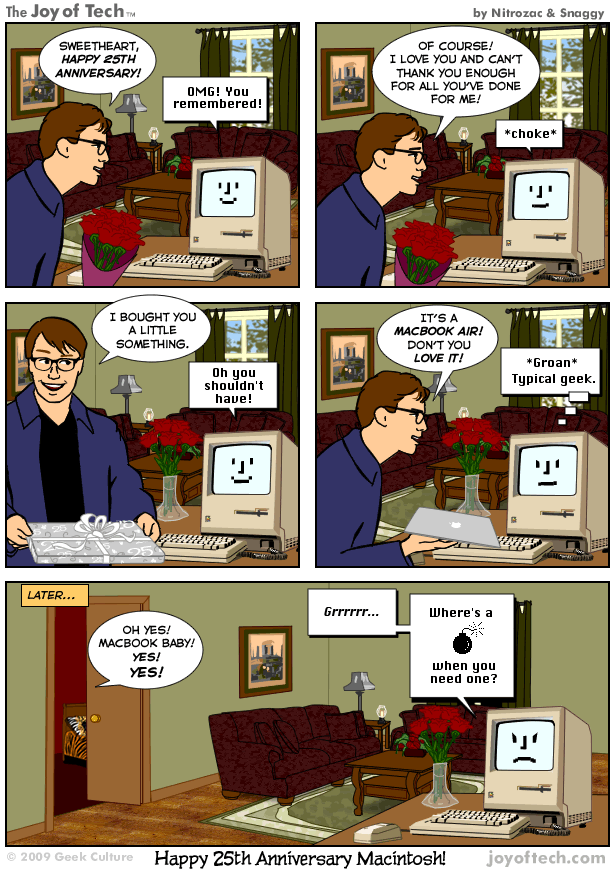
 Seems more like 50. And btw, my new technolust is a Fujitsu Lifebook.
Showing posts with label mac. Show all posts
Showing posts with label mac. Show all posts
Sunday, January 25, 2009
Mac at 25: Has it really been that long?
Has it really been twenty-five years ago that I was playing with a Mac? That I was writing articles and doing my reports on a Mac? That I thought that grayscale and lined textures were cool? That a little 3 1/2" square device could hold everything?
 Seems more like 50. And btw, my new technolust is a Fujitsu Lifebook.
Seems more like 50. And btw, my new technolust is a Fujitsu Lifebook.

Saturday, May 19, 2007
The other side of Apple's ads
This the reason why I'm in tech support.
These are the kinds of sentiments I have to deal with, even though I work with PC-people.
These are the kinds of sentiments I have to deal with, even though I work with PC-people.
Sunday, January 14, 2007
Next-Gen: Real and Phony
Next-Gen: Real And Phony
– by David Matthews 2
Apple Computer’s quasi-deity (and sometimes chairman) Steve Jobs recently made two "stunning" announcements at the 2007 Macworld Expo. The first was that Apple Computers was getting rid of the "Computers" part of its name and simply calling itself Apple Incorporated. Since they managed to resolve their trademark lawsuit with the Beatles over the word "Apple", no doubt the company was just itching to simplify themselves to just the one-fruit reference.
The second announcement was the unveiling of their latest toy: the iPhone! The merger between an iPod music player and a cellphone! You can surf the web, download music and video files, play games, AND talk on the phone!
Isn’t that great? Isn’t that wonderful? Here’s the NEXT GENERATION of technology! Here is THE FUTURE!
ZZZZzzzzzzzzz…
Somebody wake me up when the mindless jabbering settles down.
Don’t get me wrong… I’m all for technical advances. But the merging of a music player and the cellphone is NOT "next-gen"! It’s actually the status quo.
That’s the ugly and bitter truth when it comes to the iPhone: it’s neither the latest, nor the greatest, nor the next best thing since the microprocessor. It’s basically the same kind of cellphone available today with a larger hard drive for music, a Macintosh operating system, and a jazzy "iTitle" on it.
Meanwhile other computer makers are busy transforming their systems to conform to what they believe "next-gen" will be. They think that the computers of the future will no longer be beige metal boxes sitting with its own space. They think that the computer will actually be sleek and thin and fit underneath a huge flat-screen TV as just another component in a mammoth entertainment center.
If that’s all that they think computers will be in the future, I have some SERIOUS doubts about our technological progress.
For the past few decades, there have been two conflicting trains of thought about computers and where they should be heading.
The first train of thought is that computers are for business purposes only. This was the mindset of computer makers like IBM, who made their money creating huge mainframe systems that cost a fortune to have and another fortune to maintain and operate. It also wasn’t hard to figure out why since computers at that time could do very little except crunch numbers and run very limited programs.
But as computers got smaller, more affordable, and could do a whole lot more than just crunch numbers, a second train of thought developed that said that computers were for ENTERTAINMENT purposes only. They believe that computers should be playing games and keeping the masses entertained. This is the train of thought of companies like Apple as they made computers very user-friendly. It was also the train of thought of arcade video game makers like Atari, and later Nintendo and Sega. The rise of the Internet in the 1990’s solidified this train of thought as people began using the computer to play online games, download music and video, and to chat with friends, family members, and even total strangers all around the world.
Both mentalities think that theirs is the true "next-gen" mentality. The business-only people scoff at the entertainment-only people and think that playing games and stuff are just fleeting fads. The entertainment-only people think that the business-only people suck and are fanatically obsessed with security.
The truth of the matter is that NEITHER side has the exclusive on what "next-gen" will be. They don’t get it, because it won’t just be about either mentality. It will actually be both, neither, and everything in between.
Do you want to know what "next-gen" will be? Do you want to know what will be the REAL steps forward in technology? The REAL driving force for the next decade?
One word, my friends: Networking.
The name of the game for the next few decades will be getting everything interconnected. It won’t be JUST about business or JUST about playing games or JUST about surfing the web and keeping tabs with your friends, relatives, and complete strangers all around the world. It will be bringing together the things that you use in your everyday life.
Imagine buying a watch that will never need to be set or reset. A watch that will automatically correct itself and adjust for things such as Daylight Savings Time. It will always give you the correct time. If you travel from one time zone to another, your watch will automatically adjust to give you the correct time no matter where you go. This watch will keep up with your daily schedule and remind you of important events as they are occur. And it will remind you when its battery is about to expire or to let you know if there is a problem with it.
Impossible, you say? Right now, yes. But in a few years that watch will be as commonplace as iPod players are today. In fact, elements of those features are ALREADY present in other devices such as your cellphone and your computer.
That’s just one common device. There are plenty of others to go along with it.
You may have seen the commercials of the cars that will send an email report of how it is doing and when it will be due for service. That too is an example of next-generation networking, and it eventually won’t be just for expensive luxury vehicles. Pretty soon your car will be doing everything related to its own service except driving itself to the service station and giving itself an oil-change. Hopefully by then we will also eliminate the whole oil and petroleum dependency.
Over the past few years we’ve seen homes constructed already wired for networking. Putting in Cat5 cable and installing network switches is pretty much old hat. First, Cat5 cable is being replaces by Cat6, which can handle much more data than its predecessor. And second, the trend now is wireless. Oh, there will be some physical network connections still needed in the short-run, but eventually all devices will be speaking to each other through one common home network system transmitted through wireless frequencies.
You may have heard the word "bluetooth" in regards to cellphones. The wireless technology behind bluetooth appliances will eventually become the technology that connects other devices to that common home network system.
Imagine a touchscreen terminal in your kitchen. You tell the terminal what you want to cook. Your computer will do an inventory of your current supplies to determine what you have and what you need to get. It will compile a list for you of what you need from the store. Then it will give you the option to either print out the list so you can do the shopping in person, to prepare an electronic list for you to export, or it will allow you to electronically order the items and then pay for them in advance through your bank account. Then you can either pick them up at the store or else have them delivered to you for a nominal fee.
And again, elements of that idea are already present! There are refrigerators with network-connected touchscreen computers. They’re hard to find and expensive, but they exist. Touch-screen terminals for the kitchen are already in the works. And the idea of online grocery shopping and personal delivery? Already dabbled with several years ago but only failed because the idea was simply started way before its time.
How about shopping itself? Here’s how that would be done by next-gen technology: You get to the grocery store and you check in with a network-connected shopping cart with a scanner, scale, and wireless terminal built in. You upload your list or use the touch-screen to input what you need, and the terminal will tell you where in the store those items are. It may even let you know as to which item is on sale or has an electronic discount coupon. As you put each item into the cart, the scanner reads the item into the system and checks them off your list. You can use a scale to weigh certain items like fruit and then have that amount entered into the system. When you get to the cashier, he or she visually verifies the items in the cart compared to what’s in the system, and then you electronically pay for it. No more "price check" calls or questions as to how much an item costs. It’s all figured out by the time you get there. You just approve the purchase and you’re on your way. Your time at the cashier’s counter will be measured in seconds, not minutes.
That is real next-gen technology!
We hear about merging cellphones with music players and game consoles and cameras and video recorders, but that is really just a baby-step compared to the REAL next-gen technology. REAL next-gen means getting the computer OUT of the office and OUT of the living room.
There will still be an entertainment center, but rather than having the computer be just another component of it, the entertainment center itself will be the component of the home network system. Your favorite shows can be downloaded and available for you to watch at your leisure from any TV monitor in your house. You go from room to room and if there is a monitor, that feed will be available for you. You want to listen to music? Either stored or streaming audio can be sent to wireless speakers in any room you want to be in.
Phone messages can be sent to a personal communication device similar to a bluetooth earpiece. Instead of dialing a number, you simply tap the earpiece and tell the computer to dial either a number or a preset name. The earpiece would be personalized so that a call coming in for you will be sent to just YOUR earpiece.
Again, this isn’t science fiction! The bluetooth technology for telephone voice command exists right now!
Of course, these technical visions of the future, as incredible as they may be, will come with their own problems as well. The biggest issue in making things interconnected and available on a common network is one that we haven’t even begun to deal with… namely privacy.
Current cellphones have GPS devices on them to track where you are in the event of an emergency. Some companies have capitalized on this by allowing you to see where your friends and family members are at all times. Well what is to prevent a former boyfriend or girlfriend from using that same technology to track where you are at all times? What is to prevent the government from using that technology to track where you are at all times for any reason whatsoever?
The next-gen home networks will have plenty of personal information about you at its disposal, including your bank records, online purchases, favorite movies and songs, and all sorts of contact information about the people you deal with on a regular basis. That’s prime information about you and your life that anyone, including telemarketers and the government, would KILL to get!
Needless to say, if we don’t firmly deal with the issue of privacy now, we certainly won’t be able to when the REAL next-gen technology is here.
The fact the matter is that there is a definitive difference between REAL next-gen technology and hype pretending to be next-gen. REAL next-gen moves us ahead through a particular vision. Hype pretending to be next-gen is just about selling a product. We need to stop looking at the hype and start looking at what’s really coming up.
------
David Matthews 2 is a freelance writer living in the greater Atlanta area. He is a longtime computer user and has been involved with computers since the 1980’s.
This article can be distributed freely provided that it is unaltered and all proper credit is given to the author.
2007 – Get Brutal Productions
Friday, August 04, 2006
A Warning About Those "Mainstream" Sites
A Warning About Those "Mainstream" Sites
– by David Matthews 2
"But I practice safe surfing!"
Oh what a clever oxymoronic statement that is!
"Safe surfing!" There’s no such thing as "safe surfing" nowadays when it comes to the Internet! You have "UN-safe surfing", you have "SAFER surfing", and then you have "NO surfing". That’s really all of the ranges of surfing capability you have today. I don’t care how many firewalls you put up, or how many rights and privileges you put in on the computer for users, or how many anti-virus and anti-spyware programs you install, you will ALWAYS run the risk of being on the receiving end of a nasty virus or spyware program as long as you have a connection to the Internet.
And the virus or spyware program that will REALLY get you will come innocently enough from people who have no idea how it happened.
Here’s a scenario for all you computer users that might seem a little familiar… Your formerly ultra-fast computer is now running slower than molasses. Everything takes time to upload and run, even the simplest of programs on your computer. You’re getting hit with pop-up ads every few minutes. Your home page changes on a whim and you don’t really know why. Plus it constantly goes online for seemingly no reason whatsoever. (That is, of course, if you still use dial-up connections… all of you cable and DSL users are REALLY in trouble with your always-on connections!)
So you take your computer over to the local "expert" and he or she tells you that your computer is THOROUGHLY hosed with spyware and viruses. They can’t even BEGIN to tell you where they can start to salvage anything on that computer because it’s all so contaminated with spyware and adware and virus components.
And that’s when you start your list of denials.
But… but… but… you CAN’T have a virus! You have that extra-special "security program" that you paid $40 for and it’s programmed to automatically run every week. You never open strange emails! Well, except for that one from your mom that said "I Love You", but that was one time and it wasn’t even on THIS computer! You NEVER go to newsgroups, because you don’t even know how to do that. And you certainly don’t visit "THOSE" kinds of websites! (You know which ones I’m talking about.) You don’t file-share, because you don’t want to get sued, and you wouldn’t know where to start looking for "those files" anyway. All you do is just visit "mainstream sites". Big name websites. Popular websites. Places where you go get the news, the weather, the sports scores, and that’s it!
Well guess what? That’s where it happened.
You may not realize it, but so-called "mainstream websites" are the perfect place for malicious programs to be distributed. They’re visited by millions of users at various times of the day, unlike those "other websites" (i.e. porn sites, gambling sites, file-sharing sites) and they usually aren’t blocked out by network administrators… unless the admin is a liberal who hates Fox News or a conservative who hates CNN.
Now in all fairness I must point out that the groups behind the "mainstream websites" usually run a pretty tight ship. They wouldn’t want to be known as a haven for malicious programming, because it would really hurt their sites. So they’ll be quick to say that THEY don’t put any malicious programs on THEIR websites or on THEIR servers. And it’s probably true. THEY don’t allow it.
But that doesn’t mean that you can’t get malicious programs from visiting those sites.
You see, in order to pay for the online costs, mainstream websites will rent out virtual "space" to advertisers. Originally this used to be a simple banner ad that the webmaster would post on behalf of the advertiser. But the ad companies found an even better way to distribute more ads through Java and ActiveX programming. So now, instead of sending webmasters a prepared banner, they actually pay for the SPACE for advertising, which is simply a link to the advertising server.
A digital "cookie" is placed on your computer to identify you to the ad company. This "cookie" is a small text file that can have all sorts of basic information about you, your computer, how you’re connected, where in the world you’re connected in, and what sites you’ve visited. You don’t even know that it’s being done, and the file is so small that it happens in a nanosecond, even with dial-up connections. That information is fed into the ad company servers, which then uses that information to send you specific ads. You’re in New York? We’ll send you advertising for a local business. You’ve been searching for car dealerships? We’ll send you an ad for one of our dealerships. You’ve already seen the travel ads? Then here’s some stuff for an online university.
By the way, this is also where many of the pop-up ads come from nowadays. Little itty-bitty pieces of script that tells your computer to pop open a new window for their advertising server to give you ads. They can also execute invasive, intrusive, media-rich ads; the kind that will literally take over your browser to force-feed you advertising whether you want it or not. The webmaster of these mainstream sites usually have no idea whatsoever that the ad companies are doing this. They don’t know it because it’s really not happening off THEIR servers! And they will continue to be ignorant of these things until people start complaining, which they rarely do. Most users won’t complain about annoying ads. They will just surf elsewhere.
So it’s not hard to sneak something "extra" in with those ads. The ad companies are already intruding into your computer by installing the digital cookies. Why not add a few other "helpful tools"? And by "helpful" I mean helpful for THEM, not for the computer user. So they’ll throw in some adware and spyware programs into the rotation. Your browser gets the code to automatically install these programs, you get a little "Term of Agreement" message for a program that will "enhance your viewing experience", you click "yes", and it is done before your finger leaves the mouse.
Now some of these programs will do more than just "help" themselves under the pretext of "helping you". They will actually sabotage your security system. If the programmers are afraid that their programs might get "detected" by a certain anti-virus program, they will write code that will tell your operating system to disable the anti-virus program. Oh the program will sign in, but it won’t work. The scheduled security sweeps will never run, so they won’t detect the programs, nor will they detect or stop any other destructive program from being installed on your computer.
And it is all very legal. After all, YOU were the one who didn’t read the Terms of Agreement!
Now, picture this nightmare scenario: eight so-called "mainstream" websites suddenly become the source of a serious and malicious virus. Each website is run by separate sponsors, hosted on separate servers, and yet they ALL manage to be the source of this virus on the same day.
How do you think it was done? Some malicious "hacker nation" like the kind seen in the movie "Hackers" somehow broke into eight separate servers to plant their viruses and then escape sight unseen? Maybe a small team of computer experts looking to make a statement (i.e. "Sneakers")? Come on, get real.
The answer is simple… if you want to spread a virus out to as many people as possible, then you don’t HAVE to break into eight different servers to affect eight different "mainstream" websites. You just need to find your way into one… the ad server that they all link to… and put your program in their rotation as a "software enhancement". Again, the administrators of those "mainstream" web sites will never know because it’s really not on THEIR servers, so they have no control over it.
The point being made is this: just because you’re visiting "mainstream websites" doesn’t mean that you’re safe from malicious programming. In fact, your chances of getting one of those "helpful tools" actually go up when you do!
Don’t be lulled into a feeling of complicity when it comes to where you surf on the Internet. Remember that there is no such thing as "safe surfing" when it comes to the Internet. There’s a reason why it is called the World Wide WEB, and certain people are quick to use that to the fullest extent possible.
------
David Matthews 2 is a freelance writer living in the greater Atlanta area. He is a longtime computer user and has been involved with computers since the 1980’s.
This article can be distributed freely provided that it is unaltered and all proper credit is given to the author.
2006 – Get Brutal Productions
Monday, March 06, 2006
Quick word on Mac Cultists
I have an interesting quick rant out on the Brutally Honest Random Thoughts blog concerning Mac cultists, including a linked cartoon by JoyOfTech.com. By all means check it out and be sure to post your replies.
Subscribe to:
Posts (Atom)