This is what happens when you're obsessed with getting the "latest-greatest" toy... you end up with a $4000 phone bill!
This is for real. Check it out!
Wow, and I thought I went through the worst fifteen years ago when my sister ran up a $400-per-month phone bill signing on with Prodigy through long distance lines.
Oh, and dude, you're on Abum, not YouTube... because I can't find it on YouTube! Here's a hint... it's not good to name-drop on vids that end up on other websites.
(12/30 Update: I had to do a little more digging, but I finally found the YouTube video, so I replaced it, because the embedded Abum player continually started their video automatically, which really SUCKS!)
Tuesday, December 25, 2007

Saturday, November 03, 2007
Speaking of which...
Hey, speaking of that unnamed store in my previous post..
What's up with that? What's up with that whole idea that the salesman will disappear after talking with you, especially after he's leaving you to ponder something over?
For instance, you go check out monitors... the salesman immediately comes up and asks if you need any help. At THAT moment, you don't. So he leaves. But then you make up your mind and you NEED his help to get the item, and he isn't there! He's talking to a few dozen other customers, or he's gabbing away with the other salespeople. You have to wait until ANOTHER salesperson shows up and realizes that you're not just browsing.
Hey, like I said in the previous post, a person with a shopping cart in that kind of store is NOT there for browsing. They have it in their head that they are going to BUY something, and usually not the kind of stuff that they can just hold in their hands. You don't need to dog that person RIGHT as they're showing up in your department, but understand that you have a REALLY good chance that you're going to make a sale off this person. So don't blow it!
Oh, btw, for those stores who pride themselves in saying that their salespeople don't work on commission... just because they're not getting a commission for the sale doesn't mean that they're not putting in the heavy sale for things like your overpriced insurance program, and that can be a turn-off as well. Offer it, but once they say "no", respect it. I don't know why that is so hard for salespeople to understand; especially if, as you claim, they have nothing to gain either way.
As has been typical for this store, once the salesman leaves you to go check on other people, you pretty much won't see him again.
What's up with that? What's up with that whole idea that the salesman will disappear after talking with you, especially after he's leaving you to ponder something over?
For instance, you go check out monitors... the salesman immediately comes up and asks if you need any help. At THAT moment, you don't. So he leaves. But then you make up your mind and you NEED his help to get the item, and he isn't there! He's talking to a few dozen other customers, or he's gabbing away with the other salespeople. You have to wait until ANOTHER salesperson shows up and realizes that you're not just browsing.
Hey, like I said in the previous post, a person with a shopping cart in that kind of store is NOT there for browsing. They have it in their head that they are going to BUY something, and usually not the kind of stuff that they can just hold in their hands. You don't need to dog that person RIGHT as they're showing up in your department, but understand that you have a REALLY good chance that you're going to make a sale off this person. So don't blow it!
Oh, btw, for those stores who pride themselves in saying that their salespeople don't work on commission... just because they're not getting a commission for the sale doesn't mean that they're not putting in the heavy sale for things like your overpriced insurance program, and that can be a turn-off as well. Offer it, but once they say "no", respect it. I don't know why that is so hard for salespeople to understand; especially if, as you claim, they have nothing to gain either way.
Sunday, October 28, 2007
Getting talked OUT of a sale
Okay, this is an impromptu rant that really needs to be made.
Came across what I though was a really good computer deal for under $200. I won't say which store, but I will say it was the same franchise that I had the online sale problems with from my earlier article. I needed to get a replacement second computer because my current one is literally dying, and money, unfortunately, was once again a problem.
So after a little hashing over between last night and this afternoon, I came to the decision to go buy that computer.
I show up there WITH a shopping cart and ask the first salesman who dogs me to tell me about that computer other than what I can read on the little information tag.
"You really don't want to get that one."
Excuse me? Here I am with a shopping cart IN HAND ready to make a sale RIGHT THERE, and this guy is actually talking me OUT of a sale!
He tells me that this computer is running Windows Vista Basic. Yes I know this.
He tells me that it only has 512MB RAM. Yes I also know this.
He tells me that the system will run VERY slowly because of the RAM.
You're not dealing with a noobie, gramps. I've been playing this game before you even knew what a computer looked like!
I tell him EXACTLY what I would be using this for. I tell him that I'm replacing a 6-year old computer that is running on 256MB RAM, a 60GB drive that is FAILING, and a video card that refuses to work on a cold startup. I tell him that I would be using this for playing music and some modest web surfing. I even point out that I ALREADY have another computer that I do the bulk of my work with.
But no, he still wants me to look at some of the other computers with more RAM. Oh, hey look at this one... 1GB of RAM, only $400! And here's another one for $599!
Okay gramps, I'll humor you this one time... I'll look around. And then I'll return to the other computer and either you will make the sale for me or someone else will do it and HE will get his name for making the sale.
As has been typical for this store, once the salesman leaves you to go check on other people, you pretty much won't see him again.
Now mind you, as I'm trying to get talked out of this sale, ANOTHER person comes up, sees the same computer as I'm looking at, and he is ALSO getting talked out of the sale! Now this guy starts spouting off how much of a deal it is because he can tell you how much it costs to actually MAKE a computer by buying all of the components (which you can also do right there in the store). But he's also hearing the same spiel from a different salesman. "No, you don't want this, you want the more expensive computers over on the other sales island."
So needless to say, after another twenty minutes of pacing around the little sales island and looking at all of the computer and then coming back to that computer, another salesman figures out that I'm looking for some help. I tell him that I want to buy THAT computer...
"Um... I really don't think you want to get that computer.... it'll run a little slow."
Here we go again!
I give him an even SHORTER version of the story. I'm using this to replace a backup computer that is running on 256mb RAM, a 60gb drive that is FAILING, a video card that is FAILING, and it would be used for music and some modest web surfing. I tell him that I am hampered by two things, necessity and money. I've SEEN the other computer offers, and they are all outside of the affordable price range. Now can you PLEASE get me that computer?
He goes to the back, five minutes later he returns (after talking to another customer), and tells me that he just can't seem to find that computer anywhere on the shelves. Maybe there's another computer they can get for me?
Nope, there isn't. Goodbye.
And I walked. Actually I was TOO kind in that I returned the shopping cart. I should have just left it right there at the other end of the building to remind them that they LOST a sale!
They didn't even offer to box up the computer on display! If they were so desperate to sell out that series (which was their last excuse) then they should have at least offered to do that.
This store made SEVERAL mistakes that cost them a sale.
First: a person who walks into that store with a shopping cart is NOT someone who is causally browsing! That person is looking to BUY. That means that you have a REALLY good chance of making a sale right there. So the very last thing that you want to do is to talk someone OUT of making that sale!
Second: if that person is looking to make a purchase and you think that there is a problem with the product in question, then you don't try to talk that person into trying to buy a more expensive computer. The consumer sees this as bait-and-switch! If they know that you have some complaints about the product and they still want to make the sale then you MAKE THE SALE!
Third: if the product is REALLY sold out - and it's not just a convenient lie to get people to not buy the product for fear that you may have to restock it later when it is returned - then you sell the demo model at a discount! Or you offer to add something to it! If the problem really is with available RAM, then you offer to increase the RAM. That's not bait-and-switch - that's actually showing that you CARE enough to want them to enjoy the purchase.
Now the hard part... figuring out what I'll do to replace the computer that is dying. I'll probably have to go to some discount computer shop and see if they have any refurbished XP systems for that same price range. At least the people there care enough to want a sale made.
Came across what I though was a really good computer deal for under $200. I won't say which store, but I will say it was the same franchise that I had the online sale problems with from my earlier article. I needed to get a replacement second computer because my current one is literally dying, and money, unfortunately, was once again a problem.
So after a little hashing over between last night and this afternoon, I came to the decision to go buy that computer.
I show up there WITH a shopping cart and ask the first salesman who dogs me to tell me about that computer other than what I can read on the little information tag.
"You really don't want to get that one."
Excuse me? Here I am with a shopping cart IN HAND ready to make a sale RIGHT THERE, and this guy is actually talking me OUT of a sale!
He tells me that this computer is running Windows Vista Basic. Yes I know this.
He tells me that it only has 512MB RAM. Yes I also know this.
He tells me that the system will run VERY slowly because of the RAM.
You're not dealing with a noobie, gramps. I've been playing this game before you even knew what a computer looked like!
I tell him EXACTLY what I would be using this for. I tell him that I'm replacing a 6-year old computer that is running on 256MB RAM, a 60GB drive that is FAILING, and a video card that refuses to work on a cold startup. I tell him that I would be using this for playing music and some modest web surfing. I even point out that I ALREADY have another computer that I do the bulk of my work with.
But no, he still wants me to look at some of the other computers with more RAM. Oh, hey look at this one... 1GB of RAM, only $400! And here's another one for $599!
Okay gramps, I'll humor you this one time... I'll look around. And then I'll return to the other computer and either you will make the sale for me or someone else will do it and HE will get his name for making the sale.
As has been typical for this store, once the salesman leaves you to go check on other people, you pretty much won't see him again.
Now mind you, as I'm trying to get talked out of this sale, ANOTHER person comes up, sees the same computer as I'm looking at, and he is ALSO getting talked out of the sale! Now this guy starts spouting off how much of a deal it is because he can tell you how much it costs to actually MAKE a computer by buying all of the components (which you can also do right there in the store). But he's also hearing the same spiel from a different salesman. "No, you don't want this, you want the more expensive computers over on the other sales island."
So needless to say, after another twenty minutes of pacing around the little sales island and looking at all of the computer and then coming back to that computer, another salesman figures out that I'm looking for some help. I tell him that I want to buy THAT computer...
"Um... I really don't think you want to get that computer.... it'll run a little slow."
Here we go again!
I give him an even SHORTER version of the story. I'm using this to replace a backup computer that is running on 256mb RAM, a 60gb drive that is FAILING, a video card that is FAILING, and it would be used for music and some modest web surfing. I tell him that I am hampered by two things, necessity and money. I've SEEN the other computer offers, and they are all outside of the affordable price range. Now can you PLEASE get me that computer?
He goes to the back, five minutes later he returns (after talking to another customer), and tells me that he just can't seem to find that computer anywhere on the shelves. Maybe there's another computer they can get for me?
Nope, there isn't. Goodbye.
And I walked. Actually I was TOO kind in that I returned the shopping cart. I should have just left it right there at the other end of the building to remind them that they LOST a sale!
They didn't even offer to box up the computer on display! If they were so desperate to sell out that series (which was their last excuse) then they should have at least offered to do that.
This store made SEVERAL mistakes that cost them a sale.
First: a person who walks into that store with a shopping cart is NOT someone who is causally browsing! That person is looking to BUY. That means that you have a REALLY good chance of making a sale right there. So the very last thing that you want to do is to talk someone OUT of making that sale!
Second: if that person is looking to make a purchase and you think that there is a problem with the product in question, then you don't try to talk that person into trying to buy a more expensive computer. The consumer sees this as bait-and-switch! If they know that you have some complaints about the product and they still want to make the sale then you MAKE THE SALE!
Third: if the product is REALLY sold out - and it's not just a convenient lie to get people to not buy the product for fear that you may have to restock it later when it is returned - then you sell the demo model at a discount! Or you offer to add something to it! If the problem really is with available RAM, then you offer to increase the RAM. That's not bait-and-switch - that's actually showing that you CARE enough to want them to enjoy the purchase.
Now the hard part... figuring out what I'll do to replace the computer that is dying. I'll probably have to go to some discount computer shop and see if they have any refurbished XP systems for that same price range. At least the people there care enough to want a sale made.
Tuesday, July 10, 2007
Apple's dirty little iPhone/iHype secret
MSNBC's Red Tape Chronicles came up with something rather disturbing for all of you who got suckered into the whole iPhone iHype.
It seems there's an additional cost for the BATTERY.
Anyone remember the iPod's dirty little secret about its battery? You know which one... where you have a finite number of times you can charge it up and then that's it, it's dead. And you can't swap batteries without breaking the seal. The whole thing was designed so that iPod addicts would have to buy more iPod devices once their batteries die.
Well guess what? The iPhone is just as bad!
Worse yet, bloggers and MSM hacks who were ga-ga-ing over the iHype actually KNEW about this little "defect" AND SAID NOTHING, or worse yet they glossed over it.
Folks, we're not talking about a $30 music player here. We're talking about a SERIOUS $500-600 investment for the iHype ALONE. You can buy a low-level computer for that price. You can buy a Playstation 3 or an Xbox 360 for that price! And that's not covering the full service package and setup costs and everything else.
And all for an overhyped product that will spoil like the milk in your refrigerator.
If anything I'm disappointed with the bloggers for drinking the Apple Kool-Aid over the iHype. I can understand the MSM players for being essentially iHype whores, but the bloggers who joined in with it really need to rethink their game.
It seems there's an additional cost for the BATTERY.
Anyone remember the iPod's dirty little secret about its battery? You know which one... where you have a finite number of times you can charge it up and then that's it, it's dead. And you can't swap batteries without breaking the seal. The whole thing was designed so that iPod addicts would have to buy more iPod devices once their batteries die.
Well guess what? The iPhone is just as bad!
"The iPhone battery will only survive about 300-400 recharges, the company says. Because the unit is sealed, consumers can't swap out dead batteries. Instead, dead phones must be sent to Apple, where battery replacement will take three business days and cost $79 plus a $6.95 shipping charge. Those who can't live without their cell phones for those three days can rent a spare iPhone for $29.
This pricey, and apparently inevitable, aftercharge never made it into any of the voluminous news stories written and filmed about the iPhone prior to its launch on June 29. Why not?
According to the Foundation for Taxpayer and Consumer Rights, Apple's Web site made no mention of the battery fee on the morning of June 29, when thousands of Apple faithful lined up all around the country to buy the phone, which costs $500 or $600, depending on model."
Worse yet, bloggers and MSM hacks who were ga-ga-ing over the iHype actually KNEW about this little "defect" AND SAID NOTHING, or worse yet they glossed over it.
Folks, we're not talking about a $30 music player here. We're talking about a SERIOUS $500-600 investment for the iHype ALONE. You can buy a low-level computer for that price. You can buy a Playstation 3 or an Xbox 360 for that price! And that's not covering the full service package and setup costs and everything else.
And all for an overhyped product that will spoil like the milk in your refrigerator.
If anything I'm disappointed with the bloggers for drinking the Apple Kool-Aid over the iHype. I can understand the MSM players for being essentially iHype whores, but the bloggers who joined in with it really need to rethink their game.
Sunday, July 08, 2007

Saturday, May 19, 2007
The other side of Apple's ads
This the reason why I'm in tech support.
These are the kinds of sentiments I have to deal with, even though I work with PC-people.
These are the kinds of sentiments I have to deal with, even though I work with PC-people.
Saturday, March 10, 2007
Whither CompUSA – at least in Atlanta anyway
Sad tech news for all Atlanta
That’s a serious kick in the nads for people. I mean, normally you’d hear about two or three stores closing in a certain area, but not EVERY store in that chain. That’s a “save us from bankruptcy” move.
CompUSA has pinned the blame of this decision on extremely bad sales. Well I gotta call BS on that one!
It’s not bad SALES that is doing them in… it is bad SALES DECISIONS.
Let’s see if I can break this down for you so that even a corporate executive can understand what I’m trying to say here…
The name of the chain is CompUSA. It was set up to sell computers and computer-related items. That is its claim to fame. That is what got the techno-geeks and techno-newbies showing up. Once upon a time it was very good at doing just that.
It is NOT called CellphoneUSA.
It is NOT called DVD-PlayerUSA.
It is NOT called Home-Theatre-Surroundsound-SystemUSA.
It is NOT called Plasma-Screen-TVUSA.
It is NOT called TiVOUSA.
And yet all of these things started taking prominent shelf space in the local CompUSA stores, pushing the computer-related items to the far extreme walls. And by no coincidence, that’s also when they started experiencing the slacking sales.
Now I can understand the executive stupidity behind it. They feel that they needed to “compete” with Best Buy and with Fry’s Electronics and with all of the other electronics superstores that get into selling a wide variety of electronic goodies.
There is just one simple problem: the other stores didn’t pride themselves at ONLY being a computer superstore! It’s like walking into a KFC restaurant and seeing nothing but cheeseburgers and fish sandwiches and then having to ASK for fried chicken.
Krispy Kreme beats out Dunkin Doughnuts every time. Why? Because Krispy Kreme still sells doughnuts and the folks at Dunkin Doughnuts have to be reminded what the name of their franchise is. Or maybe they should just go ahead and change their name to Croissant Cuisine.
CompUSA dropped the ball when it came to selling computers. There is really no other way to put it. They dropped the ball and Best Buy and the other stores picked it up. Now Best Buy is making mad money and CompUSA is closing down stores just to stay solvent. If they want to get back what they lost, then they need to remember what the name of their store is and stick to it.
Saturday, February 03, 2007
"Console Wars"... guess who won?
Back in November I posted an article about the “new console wars” and how there was just too much damned hype about it and that they really weren’t worth the fuss and aggravation.
Here’s a quick snippet:
Listen, all you're really doing is feeding the selfish nature of your children when you buy into this hype. I'm sure the graphics and sound are phenomenal, but you shouldn't go broke looking for these things. If your kids don't have a game console at all, look a little further up the isle and grab a PS2 instead of a PS3. You'll save about $300 and your kids will have a larger number of games to pick and choose from. You buy the new console now and you're going to have to wait for the really good stuff to come out!
Bear in mind that this was back in November, when the “new console wars” were just beginning.
Well the people at MSNBC have declared the “new console wars” to be over with, and guess who came out on top?
I’ll let them break it to you…
Much ink has been spilled over the so-called “console wars” between the new Nintendo Wii, the PlayStation 3 and the year-old Xbox 360. So now that 2006 is over and the numbers have been tallied, who won the home-console slugfest?
The PlayStation 2.
That’s right. The PlayStation 2 outsold all next-gen consoles by a fairly wide margin.
And the reasons given for this “shocker”? The unrealistic price of $500 per game system, and the lack of games to play on that system. The very reasons why I was telling folks to not spend their money on the system.
As has been demonstrated time and time again, when I’m right, I’m right. That’s not arrogance… that’s experience.
And I’m GLAD that I’m right in this case. I’m sick and tired of these companies cranking out needless hype for game systems that they KNOW they will never have an adequate supply of, to play on games that they KNOW would not be available during that time, and to demand a price that they KNOW is more that it would ever be worth! I’m sick of it! And I’m glad to hear that the consumers are sick of it too!
If Sony and Nintendo and Microsoft want us to buy their “next generation” console system, then they need to add two words to their vocabulary: REVERSE COMPATIBILITY! Sony should have designed their PlayStation 3 to allow us to play PS2 games on it. Same for Microsoft’s Xbox360. They’re running on CD-ROM discs! How difficult would it be to adapt? Cripes, they probably could do that right now and release it as a firmware upgrade! Why have us use TWO separate game consoles to play these games, especially when the really cook games for the new system wouldn’t really be ready for a few more months or years?
Anyway, kudos to those of you who DID NOT drink the Jonestown Kool-Aid of hype. Maybe the console makers will actually learn something from this so that there would not be another “console war” and they will instead release games that we would really WANT to buy.
Sunday, January 28, 2007
The Computer That ALMOST Never Was
The Computer That ALMOST Never Was
My Misadventures With Online Ordering
– by David Matthews 2
I needed a new computer.
Not “want” or “would like”, but NEEDED.
The desktop computer that I was using has served me very well for over the past few years, but now it can’t handle what I need for it to do. I was running out of space, the latest version of my browsers and media programs require more RAM than my system has, and I don’t have the luxury of using my parents’ computer for things like burning video files to DVD. I’ve stopped buying games for the PC a while ago and I’ve been trying to figure out which programs I don’t use anymore just so I can squeeze some more hard drive space in for the stuff that I DO use it for. I can’t even consider upgrading the Office programs with the system I have now, and my versions of those programs have long since been “retired”.
I needed a new computer.
And yes, I am a techno-geek, but that doesn’t mean that I have money coming out of my butt to buy the latest, greatest, most advanced system available. My last name is neither “Gates” nor “Jobs”. Besides, I’m not the kind of hardcore techno-junkie that drools over the specs of the latest processor. I won’t be offended if my computer doesn’t have the LATEST processor or FASTEST video card. My interest in technology is tempered by reality. I care about computers because they are a means to an end. The “end” in this case is to get what I need to do done.
So buying a computer for me means to look at what I can afford to get. I have a certain set of conditions and a pretty low price range to work with. I wasn’t going to get a new computer that is “just slightly” faster than my current one. Unfortunately all of the computers that I was looking at that have what I’m looking for were OUT of my current price range.
Then, in my umpteenth online search, I came across a certain store sale. A brand name computer, 200 gigabyte hard drive, 1 gigabyte RAM, DVD burner, Windows XP Media Center operating system… all of the things that I’m looking for at JUST UNDER $400! It was just within my price range, so I go ahead and place the order.
Bear in mind that this is an online sale only. I could not purchase this computer at the website’s physical store just up the road from where I live. And the computer on sale is offered as “refurbished”. “Refurbished” can mean pretty much anything. “Refurbished” can mean the previous owner simply returned it. “Refurbished” could mean the computer had a defect that needed to be returned and then the store fixed the defect and restored it to its original factory specs and now needs to get it out of inventory. “Refurbished” could mean that the computer had a scratch or came without a manual. It’s potluck, but at $400, I was willing to roll the dice.
So, like I said, I placed the order. I put in the shipping information, the billing information, click send, and then wait. Hey, it WAS after business hours after all. And I’m all excited, because I though this was a GREAT deal I was getting.
The following morning I get the confirmation email. By the end of the day I got another email from the company. I thought this would be the acknowledgement that the order was shipped.
Thank you for your order! It has become necessary to cancel your order due to discrepancies in the information provided to us, in either the bill-to or the ship-to portion of your order.
Under the circumstances, we recommend that you contact our sales or customer service department by e-mail to have a sales person assist you in placing the order.
Your order number is ########.
We apologize for the inconvenience and thank you in advance for your assistance.
Bill-To and Ship-To were one and the same. The Bill-To had my credit card information.
Well I did send out the email asking for an explanation, but I also called their toll-free number and asked for customer service. And I waited. And I waited. And I waited…
A full forty-five minutes goes by before I get a very polite human who was quick to look up the order and say that there was something wrong with the credit card information and it got kicked back. He didn’t say what it was, and that it could be anything, even so much as a phone number being off, but that I should contact the credit card company to find out why. But if there’s nothing wrong with the credit card, then I should just go ahead and submit a new order.
Fortunately for me, my credit card statement was right in front of me, so I called the credit card company. Even though it was after business hours, there was no waiting with them. I spoke with a very kind and courteous woman whom I could barely hear who confirmed that my credit card was still active and in good standing. She connected me over to the bank. Again, no waiting at all, and the person I spoke with was kind and courteous and she also explained to me that not only was the card in good standing, but nobody’s made any kind of inquiry or approvals in several weeks. If any inquiries got made and then kicked back, they’d know about it.
So someone’s lying to me at this point. It probably wasn’t the human I was speaking to on the phone from customer service. The person who makes an arbitrary yes-no decision usually knows specifically what went wrong to cause the “no” decision.
To be safe, I re-did the online information – line by line – exactly as the bank has it in their records. Phone information, home address, everything. Then I submit a new order to the online company. I also send an email back to the service department explaining everything to them and telling them that if they have a problem again to please contact me immediately so we can resolve it.
The next morning, I get the acknowledgement email. An hour later, I get another email….
Thank you for your order! It has become necessary to cancel your order due to discrepancies in the information provided to us, in either the bill-to or the ship-to portion of your order.
At this point I’m pissed. I’m really pissed. Bear in mind that this is the SECOND arbitrary rejection, and one that comes after a SPECIFIC request to contact me if there is a problem. Why ask even for my work and home phone numbers if you’re not going to use them? (Well, I can guess why, but that’s for another subject.)
So I spend my lunch hour on the phone… on hold… waiting for a human.
Since I was pissed and on hold, I figured that I’d use my trusty old computer to do a little background check. I type in the company’s name and the word “complaints” in the search engine. Oh did I find PLENTY of reading material to keep me busy while I was on hold!!! Horror stories the likes of which would make miserly Scrooge look like the world’s greatest philanthropist in comparison.
A little word of advice to all companies with customer service numbers… you DO NOT want people to be sitting and stewing on hold for more than ten minutes. That just invites people to find ways to keep themselves pissed off. And if your company has a bad track record with customer service, then keeping people pissed off for more than ten minutes invites more trouble for your company.
This time I was on hold for only thirty minutes before I got to speak with a human. Again, she was very polite and listened as I explained everything to her, including how I spoke with both the credit card company and the bank to verify that everything was working and that they had not gotten any kind of notice that the card was rejected. She then says that she will manually submit the order herself.
Oh, but hold on…
“I need to get authorization. Apparently the price on this just went up to $449.”
I didn’t need to hear that! Here I am trying for three days now to get this computer and suddenly the price goes up? Red lights are flashing in my head. I’m trying to decide if I even want to go another round if I’m having to pay even more for this computer. And what happens if this one fails? Will the price go up again? Do they even have the computer or are they all sold out and they just don’t want to admit it?
“Okay, you’re all set. I’ve submitted a new order for $399.”
It’s at the same price, so I’m breathing a sigh of relief. She gives me my new order number and tells me that she’ll be sending me a new email acknowledgement and says that if this doesn’t work that I should contact my credit card company.
Actually at this point I’m thinking a lot more than that. I’m thinking that if this order gets rejected that there will not be a fourth attempt! Three strikes and you’re out. And I’m not going to be submitting a new order if the price of that computer is going to be edging up over my range.
A whole slew of options start running through my head. Whom to contact, who to complain to, and what to do. Should I call consumer reporters like Clark Howard for help? Should I join my voices in the choir of dissatisfied people from my little lunchtime reading list? Maybe I should just write an article and send it out? (Well obviously I went ahead with this idea.)
Out of laughs and giggles, I visited the physical store of this online company. It’s a national chain of stores, although it’s still not big enough for most people to recognize. I go searching for two things. First, what kind of computer I could get off the shelf, cash in hand, for the price that I’m trying to pay for the computer in question? Second, how much would a brand-new, factory-sealed, version of that computer cost?
The answer to the first question shocked me. For roughly $400, I could only get a computer that is SLIGHTLY faster or larger than my current one. Double the current RAM, maybe a slightly larger hard drive, a CD-ROM burner, and the same operating system. In other words, I’d be better off sticking with my old and faithful (and crowded) computer.
The answer to the second question didn’t really surprise me. If I bought that same computer at the physical store, I’d be paying $600 for it. That was clearly outside of my current price range.
The next morning, I get a new message. This time the message has the order number attached to it.
We are happy to inform you that your order has been completed and will be shipped to you.
This was followed by a link to their website that allows me to track the progress of the package so I know when it will arrive.
Well that’s great! Problem averted. Now it’s just a waiting game to see if my potluck gamble will pay off.
Fortunately the computer did show up as scheduled, although it wasn’t entirely a great ending. It appeared that someone didn’t plug the hard drive power cable, or that they didn’t plug it in properly and it got unplugged during boxing and shipping. In other words, when it started up, I was told I had no hard drive. Fortunately with a little help from the manufacturer’s support desk and a little experience of my own, everything was up and running.
By the way, I did eventually get a response to my initial email inquiry as to why the first order was rejected. It showed up in my inbox a couple of hours after I got the approval notice. The response was: “it appears that this matter has already been resolved.” No apologies or explanations (as requested), just that it was resolved and that was it.
So… why bother talking about this whole experience if there is a happy ending to it all? The deal has been made, the order was shipped, and the product is here… case closed.
Well that’s part of the problem right there. This whole episode was fraught with customer mismanagement, and nobody wants to talk about it because the end result is all that matters to most people. It is certainly all that the business is concerned about, and that is not good for them, especially if they’re trying to truly become a big-name brand company.
The truth of the matter is that this was a really good deal that almost did not happen!
If my need for a new computer wasn’t as strong as it was, I probably would have just called the whole thing off after the second email cancellation. I may not have even stayed on the line while being on hold for a half an hour on that second call after reading all of the horror stories about this company if I wasn’t determined to make this deal work. My otherwise cautious and cynical online mind would have told me not to go through with this.
I understand that sometimes online orders just don’t go through. Maybe the wrong numbers were put in. Maybe I put in a 6 instead of a 9. Those things happen even to the best of us. But that second rejection should not have happened if everything was double-checked and put in correctly.
At the very least an attempt should have been made to contact me before making that second cancellation. Why go through the process of getting a person’s phone number if you’re not going to use it for what it was intended for? That in and of itself sets off a few red flags. Anyone remember how telemarketers end up with our phone numbers?
The person who has to go through with a second order is already uneasy about it. Extra effort needs to be made on behalf of the company to make sure this order goes through on the second try, and it didn’t happen.
Also, it goes without saying that long waiting periods for customer service calls – or sales calls for that matter – are things that should not be tolerated. A person who calls customer service is already not a happy shopper to begin with, and they certainly should not be left to sit and stew for any longer than ten minutes. That only serves to further aggravate the situation.
Online companies need to remember that all of the jazzy sales and slick website promises in the world mean absolutely nothing if they cannot get the customer through the point-of-sale and actually deliver the product. I can understand how people can get upset at certain big-name computer distributors if their experience with customer service was anywhere as frustrating as mine was. I would have serious hesitations about making another online purchase with this company, although I have yet to say anything bad about their physical store and will probably rely on making all future purchases from there.
Ten years ago it would have been understandable to say that an online store would have problems with its customer service. But today, with dozens of online marketplaces ready to step in and provide the consumers with what they’re looking for, even the smallest of businesses really need to remember that customer satisfaction is more than just a fancy website and great sales offers. In the online world of business, customer satisfaction starts with the point of sale and it only ends when that customer is happy enough with his or her experience to let others know about it. If you cannot provide it, then you lose the very support you need to keep that business going.
------
David Matthews 2 is a freelance writer living in the greater Atlanta area. He is a longtime computer user and has been involved with computers since the 1980’s.
This article can be distributed freely provided that it is unaltered and all proper credit is given to the author.
2007 – Get Brutal Productions
Sunday, January 14, 2007
Next-Gen: Real and Phony
Next-Gen: Real And Phony
– by David Matthews 2
Apple Computer’s quasi-deity (and sometimes chairman) Steve Jobs recently made two "stunning" announcements at the 2007 Macworld Expo. The first was that Apple Computers was getting rid of the "Computers" part of its name and simply calling itself Apple Incorporated. Since they managed to resolve their trademark lawsuit with the Beatles over the word "Apple", no doubt the company was just itching to simplify themselves to just the one-fruit reference.
The second announcement was the unveiling of their latest toy: the iPhone! The merger between an iPod music player and a cellphone! You can surf the web, download music and video files, play games, AND talk on the phone!
Isn’t that great? Isn’t that wonderful? Here’s the NEXT GENERATION of technology! Here is THE FUTURE!
ZZZZzzzzzzzzz…
Somebody wake me up when the mindless jabbering settles down.
Don’t get me wrong… I’m all for technical advances. But the merging of a music player and the cellphone is NOT "next-gen"! It’s actually the status quo.
That’s the ugly and bitter truth when it comes to the iPhone: it’s neither the latest, nor the greatest, nor the next best thing since the microprocessor. It’s basically the same kind of cellphone available today with a larger hard drive for music, a Macintosh operating system, and a jazzy "iTitle" on it.
Meanwhile other computer makers are busy transforming their systems to conform to what they believe "next-gen" will be. They think that the computers of the future will no longer be beige metal boxes sitting with its own space. They think that the computer will actually be sleek and thin and fit underneath a huge flat-screen TV as just another component in a mammoth entertainment center.
If that’s all that they think computers will be in the future, I have some SERIOUS doubts about our technological progress.
For the past few decades, there have been two conflicting trains of thought about computers and where they should be heading.
The first train of thought is that computers are for business purposes only. This was the mindset of computer makers like IBM, who made their money creating huge mainframe systems that cost a fortune to have and another fortune to maintain and operate. It also wasn’t hard to figure out why since computers at that time could do very little except crunch numbers and run very limited programs.
But as computers got smaller, more affordable, and could do a whole lot more than just crunch numbers, a second train of thought developed that said that computers were for ENTERTAINMENT purposes only. They believe that computers should be playing games and keeping the masses entertained. This is the train of thought of companies like Apple as they made computers very user-friendly. It was also the train of thought of arcade video game makers like Atari, and later Nintendo and Sega. The rise of the Internet in the 1990’s solidified this train of thought as people began using the computer to play online games, download music and video, and to chat with friends, family members, and even total strangers all around the world.
Both mentalities think that theirs is the true "next-gen" mentality. The business-only people scoff at the entertainment-only people and think that playing games and stuff are just fleeting fads. The entertainment-only people think that the business-only people suck and are fanatically obsessed with security.
The truth of the matter is that NEITHER side has the exclusive on what "next-gen" will be. They don’t get it, because it won’t just be about either mentality. It will actually be both, neither, and everything in between.
Do you want to know what "next-gen" will be? Do you want to know what will be the REAL steps forward in technology? The REAL driving force for the next decade?
One word, my friends: Networking.
The name of the game for the next few decades will be getting everything interconnected. It won’t be JUST about business or JUST about playing games or JUST about surfing the web and keeping tabs with your friends, relatives, and complete strangers all around the world. It will be bringing together the things that you use in your everyday life.
Imagine buying a watch that will never need to be set or reset. A watch that will automatically correct itself and adjust for things such as Daylight Savings Time. It will always give you the correct time. If you travel from one time zone to another, your watch will automatically adjust to give you the correct time no matter where you go. This watch will keep up with your daily schedule and remind you of important events as they are occur. And it will remind you when its battery is about to expire or to let you know if there is a problem with it.
Impossible, you say? Right now, yes. But in a few years that watch will be as commonplace as iPod players are today. In fact, elements of those features are ALREADY present in other devices such as your cellphone and your computer.
That’s just one common device. There are plenty of others to go along with it.
You may have seen the commercials of the cars that will send an email report of how it is doing and when it will be due for service. That too is an example of next-generation networking, and it eventually won’t be just for expensive luxury vehicles. Pretty soon your car will be doing everything related to its own service except driving itself to the service station and giving itself an oil-change. Hopefully by then we will also eliminate the whole oil and petroleum dependency.
Over the past few years we’ve seen homes constructed already wired for networking. Putting in Cat5 cable and installing network switches is pretty much old hat. First, Cat5 cable is being replaces by Cat6, which can handle much more data than its predecessor. And second, the trend now is wireless. Oh, there will be some physical network connections still needed in the short-run, but eventually all devices will be speaking to each other through one common home network system transmitted through wireless frequencies.
You may have heard the word "bluetooth" in regards to cellphones. The wireless technology behind bluetooth appliances will eventually become the technology that connects other devices to that common home network system.
Imagine a touchscreen terminal in your kitchen. You tell the terminal what you want to cook. Your computer will do an inventory of your current supplies to determine what you have and what you need to get. It will compile a list for you of what you need from the store. Then it will give you the option to either print out the list so you can do the shopping in person, to prepare an electronic list for you to export, or it will allow you to electronically order the items and then pay for them in advance through your bank account. Then you can either pick them up at the store or else have them delivered to you for a nominal fee.
And again, elements of that idea are already present! There are refrigerators with network-connected touchscreen computers. They’re hard to find and expensive, but they exist. Touch-screen terminals for the kitchen are already in the works. And the idea of online grocery shopping and personal delivery? Already dabbled with several years ago but only failed because the idea was simply started way before its time.
How about shopping itself? Here’s how that would be done by next-gen technology: You get to the grocery store and you check in with a network-connected shopping cart with a scanner, scale, and wireless terminal built in. You upload your list or use the touch-screen to input what you need, and the terminal will tell you where in the store those items are. It may even let you know as to which item is on sale or has an electronic discount coupon. As you put each item into the cart, the scanner reads the item into the system and checks them off your list. You can use a scale to weigh certain items like fruit and then have that amount entered into the system. When you get to the cashier, he or she visually verifies the items in the cart compared to what’s in the system, and then you electronically pay for it. No more "price check" calls or questions as to how much an item costs. It’s all figured out by the time you get there. You just approve the purchase and you’re on your way. Your time at the cashier’s counter will be measured in seconds, not minutes.
That is real next-gen technology!
We hear about merging cellphones with music players and game consoles and cameras and video recorders, but that is really just a baby-step compared to the REAL next-gen technology. REAL next-gen means getting the computer OUT of the office and OUT of the living room.
There will still be an entertainment center, but rather than having the computer be just another component of it, the entertainment center itself will be the component of the home network system. Your favorite shows can be downloaded and available for you to watch at your leisure from any TV monitor in your house. You go from room to room and if there is a monitor, that feed will be available for you. You want to listen to music? Either stored or streaming audio can be sent to wireless speakers in any room you want to be in.
Phone messages can be sent to a personal communication device similar to a bluetooth earpiece. Instead of dialing a number, you simply tap the earpiece and tell the computer to dial either a number or a preset name. The earpiece would be personalized so that a call coming in for you will be sent to just YOUR earpiece.
Again, this isn’t science fiction! The bluetooth technology for telephone voice command exists right now!
Of course, these technical visions of the future, as incredible as they may be, will come with their own problems as well. The biggest issue in making things interconnected and available on a common network is one that we haven’t even begun to deal with… namely privacy.
Current cellphones have GPS devices on them to track where you are in the event of an emergency. Some companies have capitalized on this by allowing you to see where your friends and family members are at all times. Well what is to prevent a former boyfriend or girlfriend from using that same technology to track where you are at all times? What is to prevent the government from using that technology to track where you are at all times for any reason whatsoever?
The next-gen home networks will have plenty of personal information about you at its disposal, including your bank records, online purchases, favorite movies and songs, and all sorts of contact information about the people you deal with on a regular basis. That’s prime information about you and your life that anyone, including telemarketers and the government, would KILL to get!
Needless to say, if we don’t firmly deal with the issue of privacy now, we certainly won’t be able to when the REAL next-gen technology is here.
The fact the matter is that there is a definitive difference between REAL next-gen technology and hype pretending to be next-gen. REAL next-gen moves us ahead through a particular vision. Hype pretending to be next-gen is just about selling a product. We need to stop looking at the hype and start looking at what’s really coming up.
------
David Matthews 2 is a freelance writer living in the greater Atlanta area. He is a longtime computer user and has been involved with computers since the 1980’s.
This article can be distributed freely provided that it is unaltered and all proper credit is given to the author.
2007 – Get Brutal Productions
Tuesday, December 19, 2006

Friday, November 17, 2006
New console games: just not worth the hype
The person who penned the old saying "Fool me once, shame on you... fool me twice, shame on me" apparently never heard of Nintendo.
Maybe that's why the old saying has been rewritten by the White House to being "Fool me once shame.... shame on... you.... but a fool cannot be fooled again!" That's certainly the game plan of Nintendo and Sony and Microsoft in selling their overpriced, over-hyped toys. They know that there is a certain breed of fool CAN be fooled again, and it happens every single time these companies crank out their holiday hype. Those fools are commonly referred to as "parents".
You know, when Microsoft came out with the original Xbox and Sony cranked out their PS2, people were talking about how blowing $300 for a game console was maybe too much for people. Riiight... these are the same people who would pay $5000 for a Tickle-Me-Elmo doll on eBay just because they couldn't buy it at the store.
So now Sony and Nintendo are cranking out their new toys for $600, and people are lining up like drug addicts to get them.
Listen folks, take it from me: any parent who thinks that it's important to go broke to get their kid one of these overpriced and obscenely over-hyped game consoles for the holidays needs a smack upside their empty heads!
These ARE pretty good gaming consoles. But the kind of toys that they're promoting are things that are ALREADY on the market in other forms. BluRay DVD? Already out. And what's so special about it anyway? WiFi access? If you have a laptop, then odds are you have WiFi. It's called a wireless network card.
Listen, all you're really doing is feeding the selfish nature of your children when you buy into this hype. I'm sure the graphics and sound are phenomenal, but you shouldn't go broke looking for these things. If your kids don't have a game console at all, look a little further up the isle and grab a PS2 instead of a PS3. You'll save about $300 and your kids will have a larger number of games to pick and choose from. You buy the new console now and you're going to have to wait for the really good stuff to come out!
Trust me, I've been mashing buttons and destroying controllers since the days of PacMan and the original Atari game system. They're great distractions, but they're not worth pulling all-nighters for or risking your lives over.
Maybe that's why the old saying has been rewritten by the White House to being "Fool me once shame.... shame on... you.... but a fool cannot be fooled again!" That's certainly the game plan of Nintendo and Sony and Microsoft in selling their overpriced, over-hyped toys. They know that there is a certain breed of fool CAN be fooled again, and it happens every single time these companies crank out their holiday hype. Those fools are commonly referred to as "parents".
You know, when Microsoft came out with the original Xbox and Sony cranked out their PS2, people were talking about how blowing $300 for a game console was maybe too much for people. Riiight... these are the same people who would pay $5000 for a Tickle-Me-Elmo doll on eBay just because they couldn't buy it at the store.
So now Sony and Nintendo are cranking out their new toys for $600, and people are lining up like drug addicts to get them.
Listen folks, take it from me: any parent who thinks that it's important to go broke to get their kid one of these overpriced and obscenely over-hyped game consoles for the holidays needs a smack upside their empty heads!
These ARE pretty good gaming consoles. But the kind of toys that they're promoting are things that are ALREADY on the market in other forms. BluRay DVD? Already out. And what's so special about it anyway? WiFi access? If you have a laptop, then odds are you have WiFi. It's called a wireless network card.
Listen, all you're really doing is feeding the selfish nature of your children when you buy into this hype. I'm sure the graphics and sound are phenomenal, but you shouldn't go broke looking for these things. If your kids don't have a game console at all, look a little further up the isle and grab a PS2 instead of a PS3. You'll save about $300 and your kids will have a larger number of games to pick and choose from. You buy the new console now and you're going to have to wait for the really good stuff to come out!
Trust me, I've been mashing buttons and destroying controllers since the days of PacMan and the original Atari game system. They're great distractions, but they're not worth pulling all-nighters for or risking your lives over.
Monday, November 06, 2006
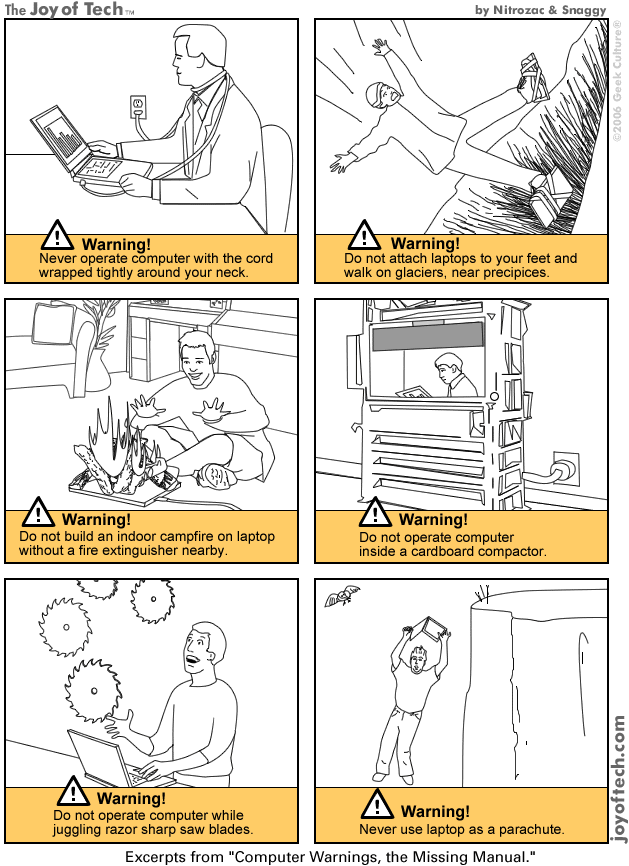
The hidden warnings
Some safety committee called the "Joy of Tech" came up with these, but the memo to include them with your computer got lost.

Friday, August 04, 2006
A Warning About Those "Mainstream" Sites
A Warning About Those "Mainstream" Sites
– by David Matthews 2
"But I practice safe surfing!"
Oh what a clever oxymoronic statement that is!
"Safe surfing!" There’s no such thing as "safe surfing" nowadays when it comes to the Internet! You have "UN-safe surfing", you have "SAFER surfing", and then you have "NO surfing". That’s really all of the ranges of surfing capability you have today. I don’t care how many firewalls you put up, or how many rights and privileges you put in on the computer for users, or how many anti-virus and anti-spyware programs you install, you will ALWAYS run the risk of being on the receiving end of a nasty virus or spyware program as long as you have a connection to the Internet.
And the virus or spyware program that will REALLY get you will come innocently enough from people who have no idea how it happened.
Here’s a scenario for all you computer users that might seem a little familiar… Your formerly ultra-fast computer is now running slower than molasses. Everything takes time to upload and run, even the simplest of programs on your computer. You’re getting hit with pop-up ads every few minutes. Your home page changes on a whim and you don’t really know why. Plus it constantly goes online for seemingly no reason whatsoever. (That is, of course, if you still use dial-up connections… all of you cable and DSL users are REALLY in trouble with your always-on connections!)
So you take your computer over to the local "expert" and he or she tells you that your computer is THOROUGHLY hosed with spyware and viruses. They can’t even BEGIN to tell you where they can start to salvage anything on that computer because it’s all so contaminated with spyware and adware and virus components.
And that’s when you start your list of denials.
But… but… but… you CAN’T have a virus! You have that extra-special "security program" that you paid $40 for and it’s programmed to automatically run every week. You never open strange emails! Well, except for that one from your mom that said "I Love You", but that was one time and it wasn’t even on THIS computer! You NEVER go to newsgroups, because you don’t even know how to do that. And you certainly don’t visit "THOSE" kinds of websites! (You know which ones I’m talking about.) You don’t file-share, because you don’t want to get sued, and you wouldn’t know where to start looking for "those files" anyway. All you do is just visit "mainstream sites". Big name websites. Popular websites. Places where you go get the news, the weather, the sports scores, and that’s it!
Well guess what? That’s where it happened.
You may not realize it, but so-called "mainstream websites" are the perfect place for malicious programs to be distributed. They’re visited by millions of users at various times of the day, unlike those "other websites" (i.e. porn sites, gambling sites, file-sharing sites) and they usually aren’t blocked out by network administrators… unless the admin is a liberal who hates Fox News or a conservative who hates CNN.
Now in all fairness I must point out that the groups behind the "mainstream websites" usually run a pretty tight ship. They wouldn’t want to be known as a haven for malicious programming, because it would really hurt their sites. So they’ll be quick to say that THEY don’t put any malicious programs on THEIR websites or on THEIR servers. And it’s probably true. THEY don’t allow it.
But that doesn’t mean that you can’t get malicious programs from visiting those sites.
You see, in order to pay for the online costs, mainstream websites will rent out virtual "space" to advertisers. Originally this used to be a simple banner ad that the webmaster would post on behalf of the advertiser. But the ad companies found an even better way to distribute more ads through Java and ActiveX programming. So now, instead of sending webmasters a prepared banner, they actually pay for the SPACE for advertising, which is simply a link to the advertising server.
A digital "cookie" is placed on your computer to identify you to the ad company. This "cookie" is a small text file that can have all sorts of basic information about you, your computer, how you’re connected, where in the world you’re connected in, and what sites you’ve visited. You don’t even know that it’s being done, and the file is so small that it happens in a nanosecond, even with dial-up connections. That information is fed into the ad company servers, which then uses that information to send you specific ads. You’re in New York? We’ll send you advertising for a local business. You’ve been searching for car dealerships? We’ll send you an ad for one of our dealerships. You’ve already seen the travel ads? Then here’s some stuff for an online university.
By the way, this is also where many of the pop-up ads come from nowadays. Little itty-bitty pieces of script that tells your computer to pop open a new window for their advertising server to give you ads. They can also execute invasive, intrusive, media-rich ads; the kind that will literally take over your browser to force-feed you advertising whether you want it or not. The webmaster of these mainstream sites usually have no idea whatsoever that the ad companies are doing this. They don’t know it because it’s really not happening off THEIR servers! And they will continue to be ignorant of these things until people start complaining, which they rarely do. Most users won’t complain about annoying ads. They will just surf elsewhere.
So it’s not hard to sneak something "extra" in with those ads. The ad companies are already intruding into your computer by installing the digital cookies. Why not add a few other "helpful tools"? And by "helpful" I mean helpful for THEM, not for the computer user. So they’ll throw in some adware and spyware programs into the rotation. Your browser gets the code to automatically install these programs, you get a little "Term of Agreement" message for a program that will "enhance your viewing experience", you click "yes", and it is done before your finger leaves the mouse.
Now some of these programs will do more than just "help" themselves under the pretext of "helping you". They will actually sabotage your security system. If the programmers are afraid that their programs might get "detected" by a certain anti-virus program, they will write code that will tell your operating system to disable the anti-virus program. Oh the program will sign in, but it won’t work. The scheduled security sweeps will never run, so they won’t detect the programs, nor will they detect or stop any other destructive program from being installed on your computer.
And it is all very legal. After all, YOU were the one who didn’t read the Terms of Agreement!
Now, picture this nightmare scenario: eight so-called "mainstream" websites suddenly become the source of a serious and malicious virus. Each website is run by separate sponsors, hosted on separate servers, and yet they ALL manage to be the source of this virus on the same day.
How do you think it was done? Some malicious "hacker nation" like the kind seen in the movie "Hackers" somehow broke into eight separate servers to plant their viruses and then escape sight unseen? Maybe a small team of computer experts looking to make a statement (i.e. "Sneakers")? Come on, get real.
The answer is simple… if you want to spread a virus out to as many people as possible, then you don’t HAVE to break into eight different servers to affect eight different "mainstream" websites. You just need to find your way into one… the ad server that they all link to… and put your program in their rotation as a "software enhancement". Again, the administrators of those "mainstream" web sites will never know because it’s really not on THEIR servers, so they have no control over it.
The point being made is this: just because you’re visiting "mainstream websites" doesn’t mean that you’re safe from malicious programming. In fact, your chances of getting one of those "helpful tools" actually go up when you do!
Don’t be lulled into a feeling of complicity when it comes to where you surf on the Internet. Remember that there is no such thing as "safe surfing" when it comes to the Internet. There’s a reason why it is called the World Wide WEB, and certain people are quick to use that to the fullest extent possible.
------
David Matthews 2 is a freelance writer living in the greater Atlanta area. He is a longtime computer user and has been involved with computers since the 1980’s.
This article can be distributed freely provided that it is unaltered and all proper credit is given to the author.
2006 – Get Brutal Productions
Saturday, May 13, 2006
Update: AOL's Safety and Security Center and Microsoft's OneCare
Okay, here’s an update on my anti-virus quest.
Once upon a time I had McAfee’s VirusScan. It’s a nice system, and when AOL had their version available for free it was a pretty good deal. VirusScan normally runs $49.95 per year, and of course if you want to get the other "suite" programs you’d have to pay for a subscription price for those as well. Or you can get the hodgepodge of other programs and then be reminded from these "security suites" that you’re not getting "total protection".
Then AOL came out with their Safety and Security Center (SSC)… based, supposedly, on McAfee’s VirusScan program. You probably saw the commercials for it, right? The commercials that talk about how "easy" this program is and how "secure" it is. Well it’s not that "easy"… and my previous post on the matter sort of proved it. (By the way, check out the comments on it… you’ll see that I wasn’t the only person who had problems with it.)
When last I left my fellow tech-heads on this subject, I was waiting for the CD to arrive from AOL. Meanwhile, I was playing around with the beta version of Microsoft’s new OneCare system.
And it was during this waiting period that I noticed something about how OneCare worked compared to SSC.
Okay, for starters, I have a small network setup here. Pretty simple combination of wired and wireless connections between two computers (and sometimes three when needed). Now I noticed that when I had the SSC on my laptop, the laptop would lose connectivity anytime I tried to transfer files over from the main desktop. This might be understandable if we’re talking a wireless-only connection and the laptop was moving around. But the laptop has been stationary, three feet away from the wireless router, and even when I ran a Cat-5 line over it would lose its connection to the router. Now if you think the problem is with the firewall, you’d be right. Internet connection, no problem. File transfers in from the host computer, big problem. But even when I programmed it to accept the transfer of files, the connection would give out for both wired and wireless any time I tried to move files in.
So guess what happened when I uninstalled the SSC and went to OneCare? You guessed it! NO problems whatsoever transferring files from the host computer!
Now folks, I use both computers for audio recordings and I move plenty of files over on a weekly basis, so file transfer is important to me. I can’t afford to play games with this process just because the all-in-one security suite wants to get picky, so that’s one big minus for the SSC.
The other thing I noticed with OneCare compared to both the SSC and the old VirusScan program is how notifications come out. Both VirusScan and SSC have pop-up window notifications that you have to MANUALLY click to turn off. These can get really annoying, especially when they’re sending updates that you have to MANUALLY click to acknowledge. With VirusScan, if you don’t click to acknowledge the updates, the program won’t reactivate to protect you. Plus I would get a nice little notice from Microsoft’s Security Center that the anti-virus has been disabled. This annoyance was even more noticeable with the SSC because of the bug with the downloaded version that refused to recognize its own version number.
Memo to McAfee and AOL: pop-up windows that you have to manually click to close SUCK! Why do you think that pop-up blocking software was the big killer application a couple of years ago? We HATE these things! We HATE these annoyances, no matter if it’s an advertisement or an important message.
OneCare, on the other hand, does its own updates, and notifies you by message balloon. This is something that goes away after a while, not something that you have to MANUALLY click to close. And it certainly doesn’t hang up the system while waiting for you to do something. If OneCare needs to get your attention for something, the taskbar icon changes color. That’s another plus for OneCare.
So a little bit less than a month goes by and I FINALLY get the full disc from AOL. At the same time, I get the notices from Microsoft that the beta testing will come to an end soon, and that I could buy the full version at a nice discounted rate ($19.95) to cover three computers. (Mind you, that deal was only because I’ve been using the beta version. Everyone else has to pay the full price of $49.95.)
I wanted to see how the "fixed" SSC would work, but at the same time the downloaded version gave me a few headaches that I didn’t need to have, even without its design bug. Obviously free is better than paying $50 a year, which was why I ditched McAfee’s full version and went with AOL’s free version of the software in the first place.
Decision, decisions.
I ended up giving my SSC disc to a good friend who needed a security system and I purchased OneCare for my computers.
Don’t get me wrong… this friend of mine is a really good one, and I wouldn’t give her a program like that if I didn’t think it would work for her. She doesn’t have a network set up for her computers (at least not yet), and while she is getting to be pretty good with the tech, she’s still a newbie in certain areas. The SSC program is designed for someone like her.
Now I would HOPE that AOL gets off their asses and fixes the downloaded version of the SSC. My guess is that since we don’t see any of their commercials about the program right now, they don’t really have that bug worked out yet.
So here’s a look at both systems based on the information I’ve gathered:
America Online’s Safety and Security Center
- All-In-One security system (anti-virus, anti-spyware, firewall, system check, anti-phishing, anti-scam)
- Based on McAfee’s VirusScan system
- FREE for AOL members
- Can be programmed to run both a full scan and a mini-scan
- Downloaded version has a bug – ordering the CD can take a month to deliver *
- Has pop-up notification windows that require manual acknowledgement
- Has a hard time working with networked computers *
(* - As of this Blog post. Subject to change.)
Microsoft’s Windows Live OneCare
- All-In-One security system (anti-virus, anti-spyware, firewall, system check, system backup)
- OneCare Firewall is based on Windows firewall provided in Service Pack 2
- Anti-Spyware is provided by Microsoft’s Windows Defender program
- Works with Microsoft Update to make sure all necessary updates are installed
- $49.95 per year for up to three computers (sorry, the free Beta trial is over)
- Can be purchased and downloaded online
- Can be programmed to run an overall tune-up or run individual components manually
- Uses message balloons and taskbar icon colors for notifications
- Works well with networked computers
And while I’m at it, here’s a quick tip for anyone getting an all-in-one security system: any new firewall program you install will need a little "get to know you" time. There are a lot of programs that use the Internet for updates and information, especially your media players like Quicktime and Real Player, and for any chat programs you may use. Be patient when you get those inquiry boxes. Remember that your new firewall doesn’t yet know what is a safe program and what is malicious. You have to teach it. This is also a good way for you to know if you have a program doing something it’s not supposed to.
Oh, and just because either all-in-one system has an anti-spyware program, that doesn’t mean you should rely on just that one system. You can only have one anti-virus program running, but you can have several anti-spyware systems. That’s why I still recommend that you getting additional free anti-spyware programs like Spybot Search & Destroy and Ad-Aware and run those programs religiously. Remember, spyware creators are more deceptive than virus creators, and they have been known to write spyware programs that will avoid detection.
Okay, here are my recommendations…
If you’re an AOL member and you don’t have a multi-computer network to deal with, go ahead and ORDER THE CD for the Safety and Security Center. DO NOT deal with the download version… at least not right now. Bear in mind that you’re going to be waiting for a while for that CD to come in, so if you already have an anti-virus program to work with, stick with it until you get that CD.
For everyone else, plop down some coin and get Microsoft’s OneCare program. Yes, yes, I know, "evil empire" and all of that crap. Suck it up, or start looking for other all-in-one programs to play with. I’m just giving you the pros and cons of these two systems. You can always try your luck with Norton or McAfee if you have a mad-hate for the geeks in Redmond.
Wednesday, March 22, 2006
Making the leap to Thunderbird
I've just made the transition in email programs to Mozilla's Thunderbird. I've been using Microsoft's Outlook Express for the past few years, pretty much because it's free and it does all of the stuff that I wanted it to do. But with Microsoft threatening to retire Outlook Express once and for all so they can push people to their full Outlook program, I figured I'd give the alternative a try. Besides, Thunderbird is FREE, and it's from the same folks who created the original Netscape Communicator system before it was bought out by AOL.
Okay, few things. First, you have to REALLY like playing around and tooling around with Thunderbird to get it the way you want it to be. The initial setup and the importing of your messages and settings and address book is REALLY neat and I have to give them credit for doing it, but you will STILL have to make some serious tweaks afterwards. There are some serious extensions that you should add in there as well. The three big ones that I've included so far (and I'm sure there will be more) are:
By the way, you can find all of these extensions at the Mozilla website if you look under Thunderbird add-ons. You'll also find plenty of themes that you can use. My personal favorite is the one that makes Thunderbird look like Outlook. Most of the themes are companions to the ones used for the Firefox browser, which only makes sense since it's also a Mozilla creation.
That brings me to the bad part about this program. Yes, you can download and install themes and add-ons so you can customize Thunderbird, but unlike Firefox, where you can simply click-to-install, you have to RIGHT-click and select "Save As..." to save the program to your computer, and then click on the INSTALL button on Thunderbird to find the program and then install it. It's a few extra steps, and it can get a little annoying compared to doing the same kind of installation for Firefox.
Thunderbird has a few extra goodies as well that Outlook does not have, such as the ability to enter smileys and a built-in junk email detector that will also warn you about potential scams. It's also pretty good at setting up and using multiple user identities and multiple mailboxes, including web-based mailboxes such as gmail.
Thunderbird is definitely not for the relative tech newcomers, at least not right now, but it is superior alternative to using Outlook Express.
Okay, few things. First, you have to REALLY like playing around and tooling around with Thunderbird to get it the way you want it to be. The initial setup and the importing of your messages and settings and address book is REALLY neat and I have to give them credit for doing it, but you will STILL have to make some serious tweaks afterwards. There are some serious extensions that you should add in there as well. The three big ones that I've included so far (and I'm sure there will be more) are:
- "Minimize to Tray" - which allows me to minimize the whole program to a little icon on the system tray (really neat)
- "Buttons!" - which adds a few additional and very helpful toolbar buttons
- "Signature Switch" - which gives you multiple signatures for each user identity that you can use instead of just one per identity. This is something that Outlook Express offers automatically but is an add-on for Thunderbird.
By the way, you can find all of these extensions at the Mozilla website if you look under Thunderbird add-ons. You'll also find plenty of themes that you can use. My personal favorite is the one that makes Thunderbird look like Outlook. Most of the themes are companions to the ones used for the Firefox browser, which only makes sense since it's also a Mozilla creation.
That brings me to the bad part about this program. Yes, you can download and install themes and add-ons so you can customize Thunderbird, but unlike Firefox, where you can simply click-to-install, you have to RIGHT-click and select "Save As..." to save the program to your computer, and then click on the INSTALL button on Thunderbird to find the program and then install it. It's a few extra steps, and it can get a little annoying compared to doing the same kind of installation for Firefox.
Thunderbird has a few extra goodies as well that Outlook does not have, such as the ability to enter smileys and a built-in junk email detector that will also warn you about potential scams. It's also pretty good at setting up and using multiple user identities and multiple mailboxes, including web-based mailboxes such as gmail.
Thunderbird is definitely not for the relative tech newcomers, at least not right now, but it is superior alternative to using Outlook Express.
( Click here to read about my original leap to the Firefox browser... )
Monday, March 06, 2006
Quick word on Mac Cultists
I have an interesting quick rant out on the Brutally Honest Random Thoughts blog concerning Mac cultists, including a linked cartoon by JoyOfTech.com. By all means check it out and be sure to post your replies.
Sunday, February 05, 2006
Alert: AOL’s Safety and Security Center – DO NOT DOWNLOAD!
Okay boys and girls, you’ve probably seen the ads for America Online’s new Safety and Security Center. This is their all-in-one center for anti-virus protection, anti-spyware protection, firewall protection, and computer checkup along with a couple of other features that you can put in at an additional cost.
Up until this point, AOL users were able to get a FREE version of McAfee’s VirusScan program when they upgraded to the new Version 9 Security Edition of AOL. But now that the SSC is out, and it’s anti-virus system is “powered by McAfee”, that option has more or less gone away.
Well I wanted to give this new system a try, so I went ahead and downloaded it from AOL to my laptop computer. I figured that if it worked, I’d be able to put it in on my main computer and tell other people about it so they could run it as well.
It’s a good thing that I just put it on my laptop and not on all computers.
For the first week things were going fine. I got the occasional notice about the software being upgraded, and it ran the scheduled scans.
Then it went crazy. I was getting update notices every few minutes! Some of the notices wouldn’t even close, which would force me to close them through Task Manager, which would also close my link to AOL. Look, ONE notice per day is enough, especially if you have to manually close them.
Then I was getting this message occasionally: “We are unable to upgrade your Anti-Virus program. Please reboot your computer so we can try again.”
Uh, excuse me? Reboot my computer so YOUR program can check for even MORE upgrades so you can hit me with even MORE notices? No, I don’t think so.
Needless to say, I’m not happy with AOL’s Safety and Security Center.
So after repeated uninstalls and reinstalls of the SSC – and one IGNORED email message - I finally go on AOL and hit up their live tech support for some assistance. The first support person told me that my AOL is corrupt and that I need to not only uninstall the SSC, but also AOL itself, and then download and reinstall everything. That took about two hours to do (thank you broadband!) but by the evening I was right back to square one with the repeated notices.
Went back to the live tech support…
Attempt one: Before I could even say two words, I got “Session has expired!” Expired? WTF???
Attempt two: I actually got a live person, who then said that they were experiencing some problems with the anti-virus program and wanted me to open the SSC to check the Virus Definitions. Unfortunately right as he was asking me this, that damned update notice hit again and refused to close. I had to force it closed through Task Manager, which shut the whole SSC down and disconnected me from the live tech support chat.
Attempt three: I got a different live person, and after explaining the situation quickly, he asked me to check my installation CD. Uh, no, I didn’t install this from a CD. I downloaded this from the website like those commercials said that I should do! Fortunately I made sure I had the SSC program up so I could find out exactly where the problem is as this person explained it to me.
Here’s the skinny, folks: The version that you download from AOL has a bug in it. That bug blanks out the Virus Definition field. The SSC doesn’t recognize the latest upgrade (because the field is blank) so it will continually download it, thus giving you the continual update message.
So until AOL gets around to actually fixing this problem, this is what you need to do: DO NOT DOWNLOAD THE PROGRAM! I’m serious. Go to keyword “SAFETY ROM” and order their free CD of the SSC.
If you’re currently using the SSC and you don’t have any problems with it, hey, great, more power to you. Count your blessings and hope that it stays that way.
If you’re currently using the SSC and are getting the same repeated notices like I have, go ahead and order the free CD, then uninstall the whole SSC, and then hope you still have your previous anti-virus program to use while you’re waiting for the CD to arrive.
I’m currently trying Microsoft’s Windows OneCare Beta program, which is similar to AOL’s program only it uses its own anti-virus program, anti-spyware program, and the built-in firewall from XP Service Pack 2. Right now it’s free (because it’s in beta), but they will be charging for it in the future, so this will just be an interim program. But right now, I'm not getting a million notices every five-ten minutes and I'm not getting prompted to reboot my computer because their program doesn't want to work.
Meanwhile, AOL definitely needs to do something about their SSC program! I’m one of the more tech-friendly people you could ever know, and if this program could get under MY skin, imagine the kind of aggravation that other people are experiencing with it! Either they need to put a notice up on their website about getting the program through the FREE CD, or they need to stop running those ads telling people to download the program - or preferably both.
Oh, and AOL? Remember the LAST time you had something "powered by..."? It was the browser, and it was the reason why most of your AOL people ended up either using Microsoft's full Internet Explorer or using Netscape (which you ended up buying outright) or getting Mozilla's Firefox. Next time, don't play around with this "powered by" crap.
I’ll give you an update on this after I get the CD from AOL.
Up until this point, AOL users were able to get a FREE version of McAfee’s VirusScan program when they upgraded to the new Version 9 Security Edition of AOL. But now that the SSC is out, and it’s anti-virus system is “powered by McAfee”, that option has more or less gone away.
Well I wanted to give this new system a try, so I went ahead and downloaded it from AOL to my laptop computer. I figured that if it worked, I’d be able to put it in on my main computer and tell other people about it so they could run it as well.
It’s a good thing that I just put it on my laptop and not on all computers.
For the first week things were going fine. I got the occasional notice about the software being upgraded, and it ran the scheduled scans.
Then it went crazy. I was getting update notices every few minutes! Some of the notices wouldn’t even close, which would force me to close them through Task Manager, which would also close my link to AOL. Look, ONE notice per day is enough, especially if you have to manually close them.
Then I was getting this message occasionally: “We are unable to upgrade your Anti-Virus program. Please reboot your computer so we can try again.”
Uh, excuse me? Reboot my computer so YOUR program can check for even MORE upgrades so you can hit me with even MORE notices? No, I don’t think so.
Needless to say, I’m not happy with AOL’s Safety and Security Center.
So after repeated uninstalls and reinstalls of the SSC – and one IGNORED email message - I finally go on AOL and hit up their live tech support for some assistance. The first support person told me that my AOL is corrupt and that I need to not only uninstall the SSC, but also AOL itself, and then download and reinstall everything. That took about two hours to do (thank you broadband!) but by the evening I was right back to square one with the repeated notices.
Went back to the live tech support…
Attempt one: Before I could even say two words, I got “Session has expired!” Expired? WTF???
Attempt two: I actually got a live person, who then said that they were experiencing some problems with the anti-virus program and wanted me to open the SSC to check the Virus Definitions. Unfortunately right as he was asking me this, that damned update notice hit again and refused to close. I had to force it closed through Task Manager, which shut the whole SSC down and disconnected me from the live tech support chat.
Attempt three: I got a different live person, and after explaining the situation quickly, he asked me to check my installation CD. Uh, no, I didn’t install this from a CD. I downloaded this from the website like those commercials said that I should do! Fortunately I made sure I had the SSC program up so I could find out exactly where the problem is as this person explained it to me.
Here’s the skinny, folks: The version that you download from AOL has a bug in it. That bug blanks out the Virus Definition field. The SSC doesn’t recognize the latest upgrade (because the field is blank) so it will continually download it, thus giving you the continual update message.
So until AOL gets around to actually fixing this problem, this is what you need to do: DO NOT DOWNLOAD THE PROGRAM! I’m serious. Go to keyword “SAFETY ROM” and order their free CD of the SSC.
If you’re currently using the SSC and you don’t have any problems with it, hey, great, more power to you. Count your blessings and hope that it stays that way.
If you’re currently using the SSC and are getting the same repeated notices like I have, go ahead and order the free CD, then uninstall the whole SSC, and then hope you still have your previous anti-virus program to use while you’re waiting for the CD to arrive.
I’m currently trying Microsoft’s Windows OneCare Beta program, which is similar to AOL’s program only it uses its own anti-virus program, anti-spyware program, and the built-in firewall from XP Service Pack 2. Right now it’s free (because it’s in beta), but they will be charging for it in the future, so this will just be an interim program. But right now, I'm not getting a million notices every five-ten minutes and I'm not getting prompted to reboot my computer because their program doesn't want to work.
Meanwhile, AOL definitely needs to do something about their SSC program! I’m one of the more tech-friendly people you could ever know, and if this program could get under MY skin, imagine the kind of aggravation that other people are experiencing with it! Either they need to put a notice up on their website about getting the program through the FREE CD, or they need to stop running those ads telling people to download the program - or preferably both.
Oh, and AOL? Remember the LAST time you had something "powered by..."? It was the browser, and it was the reason why most of your AOL people ended up either using Microsoft's full Internet Explorer or using Netscape (which you ended up buying outright) or getting Mozilla's Firefox. Next time, don't play around with this "powered by" crap.
I’ll give you an update on this after I get the CD from AOL.
Sunday, December 18, 2005
‘Tis the Season… for Spyware!
‘Tis the Season… for Spyware!
- by David Matthews 2
Christmas is coming, the coffers are getting fat…
Please put some spyware in the old man’s hat.
Okay, so I’m no Charles Dickens, but I am pretty good at seeing certain trends, and one of them is fast upon us.
Christmastime is always the best time for people to get computers. Stores are eager to pick up sales, people are willing to spend more money than at any other time of the year, and with a new Windows operating system on the horizon, computer prices are lower than they have ever been before. So if you’ve never had a computer before, or if you need to get a new computer, now is of course the BEST time to get one.
Unfortunately Christmastime is also the perfect season for really nasty and unscrupulous cyber-people to strike. They like to call themselves "intelligence collectors" or "marketing specialists" or "information marketers" or "digital research specialists" or any number of cute corporate-sounding names that make what they do seem innocuous. But we know them best as virus-writers, spyware-senders, Adware-senders, and SPAMMERS.
Christmastime is the perfect storm for these digital parasites. They know that we’re eager to spend money now more than any other time of the year. They know that there are plenty of markets willing to pay them to hawk their wares. And most importantly, they know that with all of these people getting new computers, there is a fresh crop of cyber-newbies that are the easiest targets to their plans.
Once upon a time, virus-writers were interested in how much chaos they could cause. They were looking to take over as many systems as possible so they could use them to destroy other computer networks and prove just how "powerful" they are. Some are still doing that, but the bulk of the virus-writers now call themselves "marketers" and they sell themselves as being able to sell a client’s wares to the masses. They’re not interested in destroying your computer, per se, because that would hurt their bottom line. Instead what these people want to do is to take over your computer so that it becomes their advertising machine.
Here’s a little oddity for you… you buy a new computer, you sign up with a new service like AOL or Earthlink, you start surfing the mainstream websites, and a few weeks later… that ultra-fast computer is suddenly getting slower and slower. Not only that, but little pop-up windows start to appear, even though you have a whole plethora of pop-up blocking programs in place. You could even be offline and those pop-ups will magically appear!
Congratulations! You’ve got Adware!
I’m sure that some of you are scratching your heads, wondering just how the hell this happened. You didn’t surf to any strange websites. You didn’t open up any stupid email programs. You didn’t visit the newsgroups… if you even knew what or where newsgroups are.
And that’s the thing… Spyware and Adware senders aren’t lurking in the fringes anymore. They’re hiding in plain sight in mainstream websites. You know those otherwise innocuous ads that you see on the news websites and the weather websites and the sports websites? Those ads don’t really reside on the website. Those ads really reside on a separate web server, which the web page calls upon when you download their page. (Note: every webpage that you visit is actually downloaded to your computer, albeit temporarily.) Hidden programming tells your browser to download all of the programs needed to "best view" that page, and imbedded in that programming is usually a Java script or ActiveX control that also tells your computer to download the Adware or Spyware program. The next thing you know, your anti-virus program has been disabled, your anti-spyware program has been disabled, and you’re getting more pop-ups than ever before because all of those pop-up blocking tools on all of those browser toolbars people love to give you have been bypassed.
It’s also important to note that the people who run those mainstream websites with all of the Adware often have no idea what’s going on. All they know is that these advertising companies are paying them to put up their ads, and possibly letting them know how many people visit their site. And if they DO know that these advertising companies are doing more than just sending ads, then they’re usually nonchalant about it. After all, it’s not coming from THEIR servers, so why should they be concerned?
So what do you need to do?
Well for those of you who are getting a new computer this holiday season (or for any time) here are a few things that should be added to your "must get" list along with the obligatory bushel of batteries.
Invest in an anti-virus program and check it regularly! America Online users can get a free version of McAfee’s VirusScan, but they have to manually look for it and download it to their computer. It sucks, but at least they’re offering it for free. Be sure to check with your service provider to see if they offer any kind of free security packages. If not, then make sure that your new computer includes some kind of security package. If it doesn’t, then buy one. It’s worth the cost. And once you do get it, make sure that you check it regularly so that you know that it is not only updated but also working. Remember that some Spyware and Adware programs are designed to disable anti-virus programs if you’re not vigilant about their use.
Download "Spybot Search & Destory" and "Ad-Aware"! These are FREE programs that look for and remove Spyware, Adware, and even certain tracking cookies that can be used to track your web surfing habits. And like the anti-virus programs, these are programs that you have to be vigilant about in regards to updates and regular scans of your hard drive.
Download Mozilla’s Firefox Browser and the "Adblock" extension! This really should be your preferred browser for any kind of personal web surfing, especially for visiting the so-called "mainstream" websites. The people at Mozilla are the same ones who created the original Netscape browser (before they sold it to America Online) and elements of that browser were later incorporated into Internet Explorer. The Firefox browser is completely FREE and can be customized in ways that neither IE or Netscape could. One unique extension is called "Adblock", and it is probably the most effective tool for online users, because it allows you to block images and certain scripts that pertain to advertising. You can even use it to block whole servers, so that no advertising can ever reach your computer from that server. Not only do web pages upload faster once the advertising has been removed, but it also blocks the commands that would order your computer to download spyware. (You may also want to consider using Mozilla’s Thunderbird email program, since it also has built-in Spam-blocking tools and the same level of customization as Firefox.)
Of course as more and more people jump to Firefox, the greater the chances are that Adware and Spyware creators will come up with ways to sneak their wares in through this browser as well. But right now having this edge over the digital parasites helps keep your computer clear of their programs.
Adding these things to your new computer’s gift list will help make sure that your holiday present doesn’t become an expensive holiday paperweight by New Year’s Day. And of course the best part is that most of these software toys are FREE… which is good because getting your computer cleared of that nasty Spyware, Adware, and viruses is pretty expensive. You certainly don’t want to be spending even more money than you have to.
And for those of you who are already online, now is certainly the perfect time to make sure that your online protection tools ARE already in place and updated. Remember that this is the time of year that the "marketers" have been waiting for, because it’s Christmastime for them when they can usurp your computer.
------
David Matthews 2 is a freelance writer living in Georgia. He has been around computers in one form or another since the 1980’s.
This article may be distributed freely only so long as it is reprinted in its entirety, with all proper credit given to the author.
2005 – Get Brutal Productions
Sunday, November 20, 2005
Moving to Vista? Not on THAT computer!
Moving to Vista? Not on THAT computer!
– by David Matthews 2
After five years of talk and five years of teasing, Microsoft has announced that they are ALMOST ready with their new operating system: Windows Vista.
So… what the hell does that mean to you?
It’s a fair question to ask. After all, it’s been a while since people were concerned about a new operating system from Microsoft. So here’s a quick word of advice to anyone even considering getting the latest and greatest in Windows…
Save your money now!
I’m serious. You’ll need that money to buy brand new computers, because whatever computer that you’re using now will not be powerful enough to use Vista!
The key thing about any major upgrade in operating systems is that they demand a whole lot more from your computer than their predecessors ever did.
Today, you can get away with running Windows XP on a computer with an Intel Pentium III processor, 128MB RAM, 20GB hard drive, and 32MB video memory. It may run slowly, and you probably wouldn’t want to play any games on it outside of the simple ones pre-installed, but you can still use it for whatever simple applications you’re working on. Compose a letter? Absolutely. Surf the web? Sure.
But that kind of computer won’t even BEGIN to handle the requirements of Windows Vista. It wouldn’t even be able to get past the Vista startup screen. The installation disc would probably even spit out of its drive in disgust.
In fact, the ONLY computers that will be able to handle Microsoft Vista will be the high-end expensive ones you see on the shelf from now until its official release. Yes, we’re talking the computers that you see on the shelves today that run anywhere between $2000 and $5000, and the high-end computers that have YET to be created and put out to market.
Why, you ask, is there so high of a requirement hurdle? Well it pretty much has to do with what we EXPECT that operating system to do.
Back in the days when computers were only used by geeks (back when Bill Gates was just millionaire and not a billionaire), operating systems had a very limited function. They basically served as gateways to the programs you used.
But now we’re asking those same operating systems to do a lot more for us. We expect that operating system to manage our files and deal with multimedia applications like music, sound clips, and video. We expect our operating system to integrate and utilize multiple applications and deal with more than one program running at any given time. We expect our operating system to handle the Internet and all of the applications involved with it.
And on top of that, the computer is now being used by more people who AREN’T geeks. People who take great PRIDE in calling themselves “computer-illiterate”. People who don’t know how to defrag their own computer or run regular systems checks, or even know how to go out to Microsoft’s website and download the latest software patches and security upgrades. People who EXPECT their computer to be smart enough to deal with spyware and viruses. THEY don’t know how to do these things themselves, and they lack the mental discipline to remind themselves to do these things, so they expect their computer’s operating system to do it all for them.
That’s a lot of work. And the more that people expect of their computer’s operating system, the more resources that are needed to do all of those additional features.
 And let’s not forget some of the other little things that just look nice for an operating system. Themes, icons, shortcuts, a customizable menu, taskbars, allowing any image file to be used as a desktop wallpaper… even the little button that says “Start” requires little bits of complex coding. Programmers call this stuff Graphical User Interface, or GUI. Well the earlier Windows programs had some relatively simple GUI. Windows XP made it a little more complex, but Vista will have even MORE complex GUI to deal with… such as transparent toolbars so you can see the desktop and the desktop wallpaper. The end result will look really neat, but in order to pull it off, Vista will require more resources than your average computer can provide.
Then again, there’s the OTHER big reason why the debut of a new operating system is considered a special occasion: because it encourages people to get brand new computers! All your computer stores and media outlets know that people will be curious about Vista, and they’ll want to see if it is as good as Microsoft expects it to be.
And believe me when I say that the store managers and salespeople are SALIVATING at the opportunity to tell their customers that THEY WILL have to get brand new computers to play with Vista, because by then they’ll have those new computers on the shelves. And let’s not forget the big companies that pride themselves in having the “latest and greatest”. They’ll want to make sure that they have Vista on their computers, if nothing than just for bragging rights. Corporate executives and salespeople LOVE being able to tell their friends and clientele that they’re up-to-date with technology.
So go ahead and start pricing those high-end computer now and start saving your money. The good news is that those high-end computers out today will not only be able to use Windows Vista when it comes out, but by the time Vista does get released, those same computers will be a whole lot cheaper. But if you’re still using the same computer for over a year, don’t even THINK of being able of using it for the next operating system.
-----------------------------------------------------------------------------
David Matthews 2 is a freelance writer living in the greater Atlanta area. He is a longtime computer user and has been involved with computers since the 1980’s.
This article can be distributed freely provided that it is unaltered and all proper credit is given to the author.
2005 – Get Brutal Productions
Subscribe to:
Posts (Atom)